Buyer next step
Turn this guide into a sourced PPE shortlist with standards, quantities, and role-based kit notes.
Planning tools
Use these tools before moving from this guide into quantities, sizing, labels, or RFQ planning.
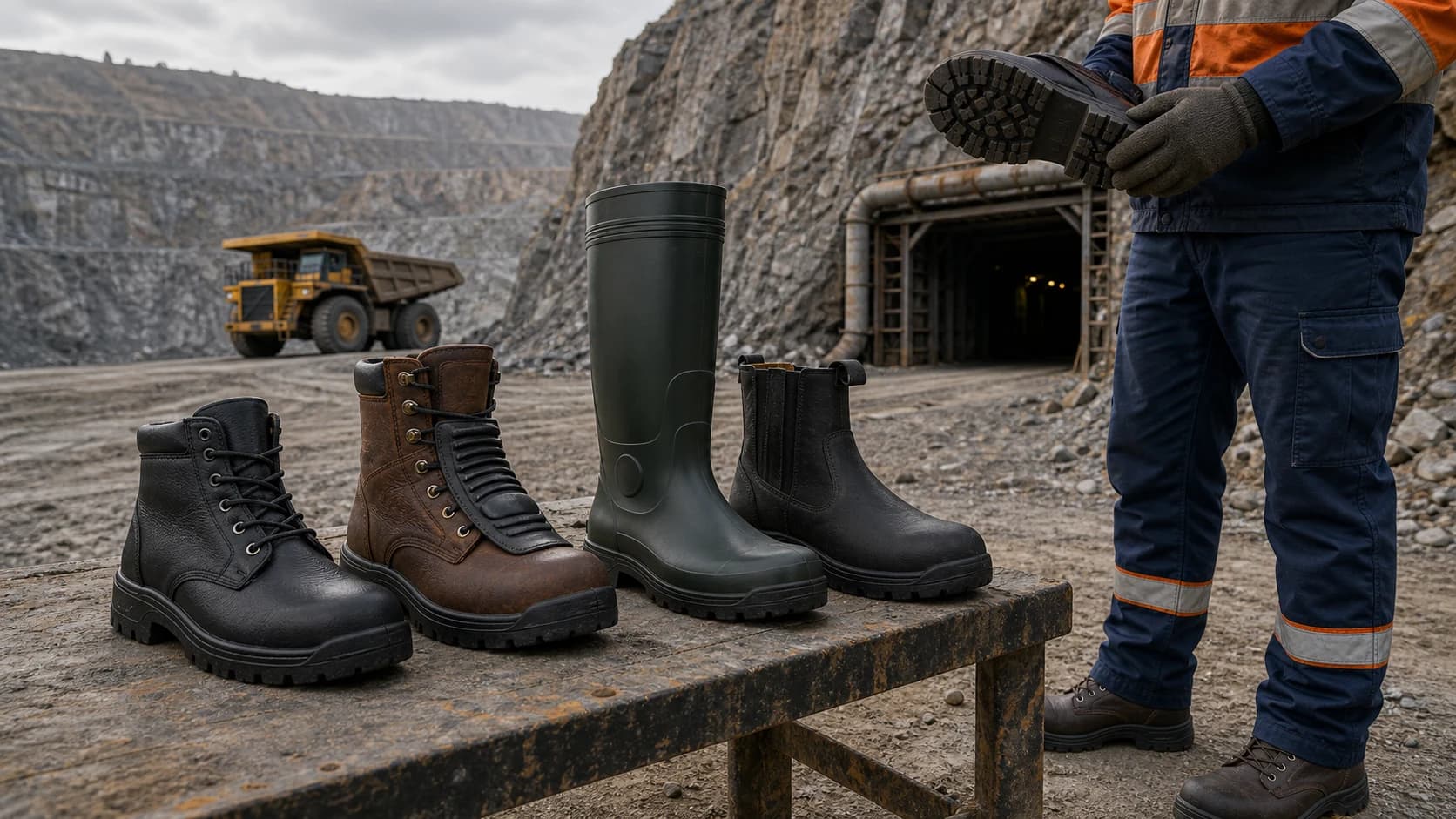
Mining and quarry safety boots should be bought by hazard, work area, fit, and documented performance—not by a product name such as “mining boot.” A driller on broken ground, a crusher attendant on wet stairs, a mobile-equipment operator moving between cab and haul road, and a maintenance worker handling heavy components may need different combinations of toe, top-of-foot, underfoot, outsole, wet-work, electrical, and chemical protection.
This guide is for mine and quarry safety managers, procurement teams, contractors, and distributors building a bulk footwear specification. It complements the Mining PPE Checklist by Task, which covers complete task kits, and the Open-Pit vs Underground Mining PPE guide, which compares whole work areas. Here, the decision stays on footwear.
PPE supports the mine's hazard assessment, ground and traffic controls, housekeeping, drainage, guarding, isolation, training, and exposure programs. It does not make an uncontrolled task safe. Start with the Mining and Quarrying PPE solution when the footwear order is part of a wider site package.
Quick Answer: Build the Boot Specification in Seven Steps
Do not begin a mining safety boot RFQ with “steel toe, all sizes.” Use this sequence:
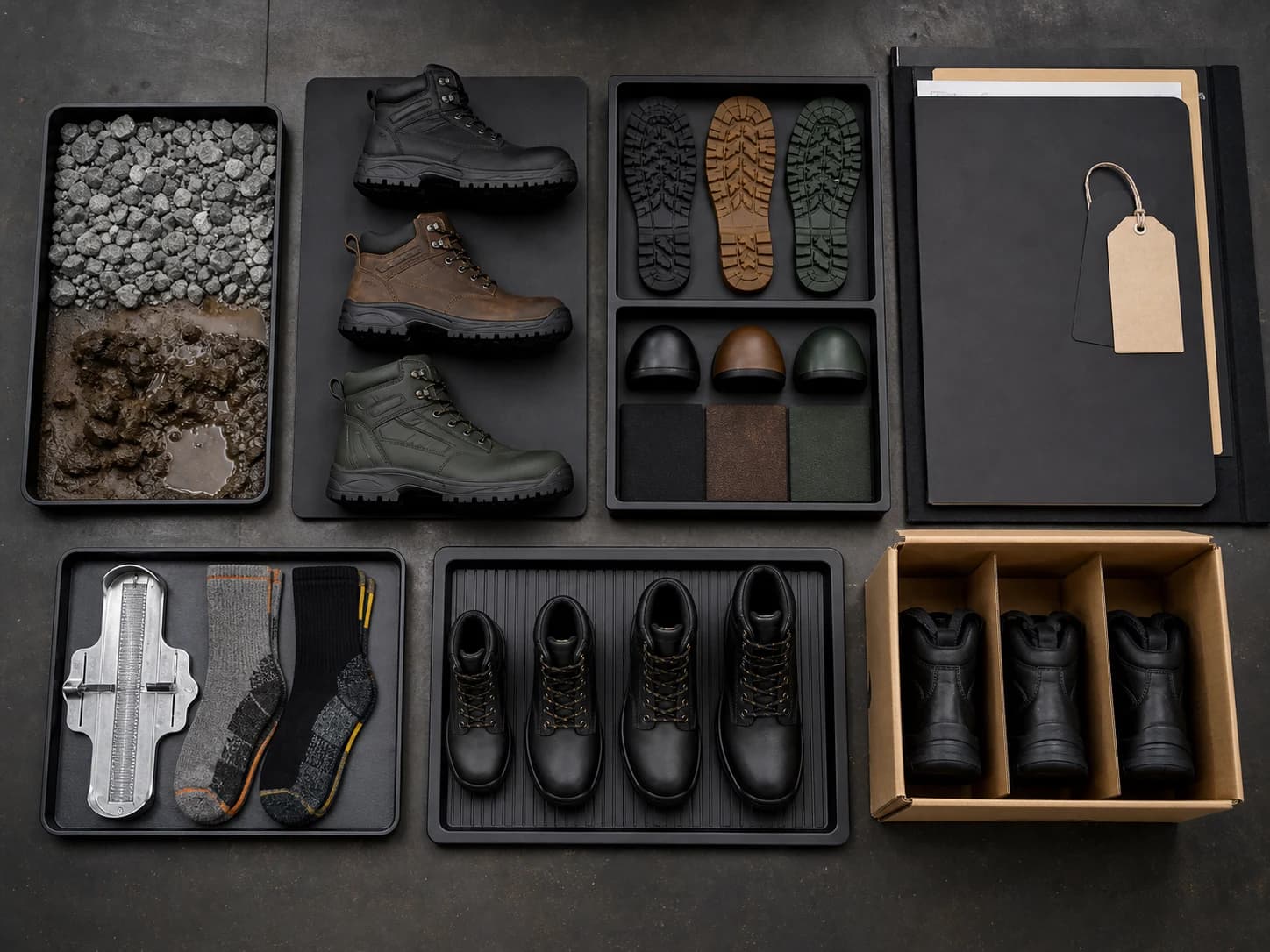
- Map the work. List the mine or quarry area, role, task, walking surface, weather, contaminants, mobile-equipment interaction, climbing, and maintenance state.
- Name each foot hazard. Separate toe impact or compression, metatarsal impact, underfoot puncture, slip or terrain, water or mud, electrical exposure, chemicals, heat, cold, and hygiene needs.
- Identify applicable rules. Record the jurisdiction, mine standard, buyer standard, required edition, and any site-specific marking.
- Request evidence. Ask for label photographs, product data, test or certificate references, instructions, limitations, material declarations, and traceability for the exact model offered.
- Trial the complete boot. Test sizes, widths, socks, insoles, trousers, gaiters, ladders, stairs, pedals, walking routes, and cleaning method with representative workers.
- Approve controlled variants. Freeze the model, construction, protection markings, size curve, packaging, and permitted substitutions after review.
- Plan replacement stock. Set inspection triggers, quarantine rules, spare-size coverage, reorder points, and lead-time assumptions before the first bulk shipment.
The result may be two or three controlled footwear families rather than one universal boot. Use the Safety Boot Size Guide during the size trial and the PPE Quantity Calculator when setting initial issue and spare quantities.
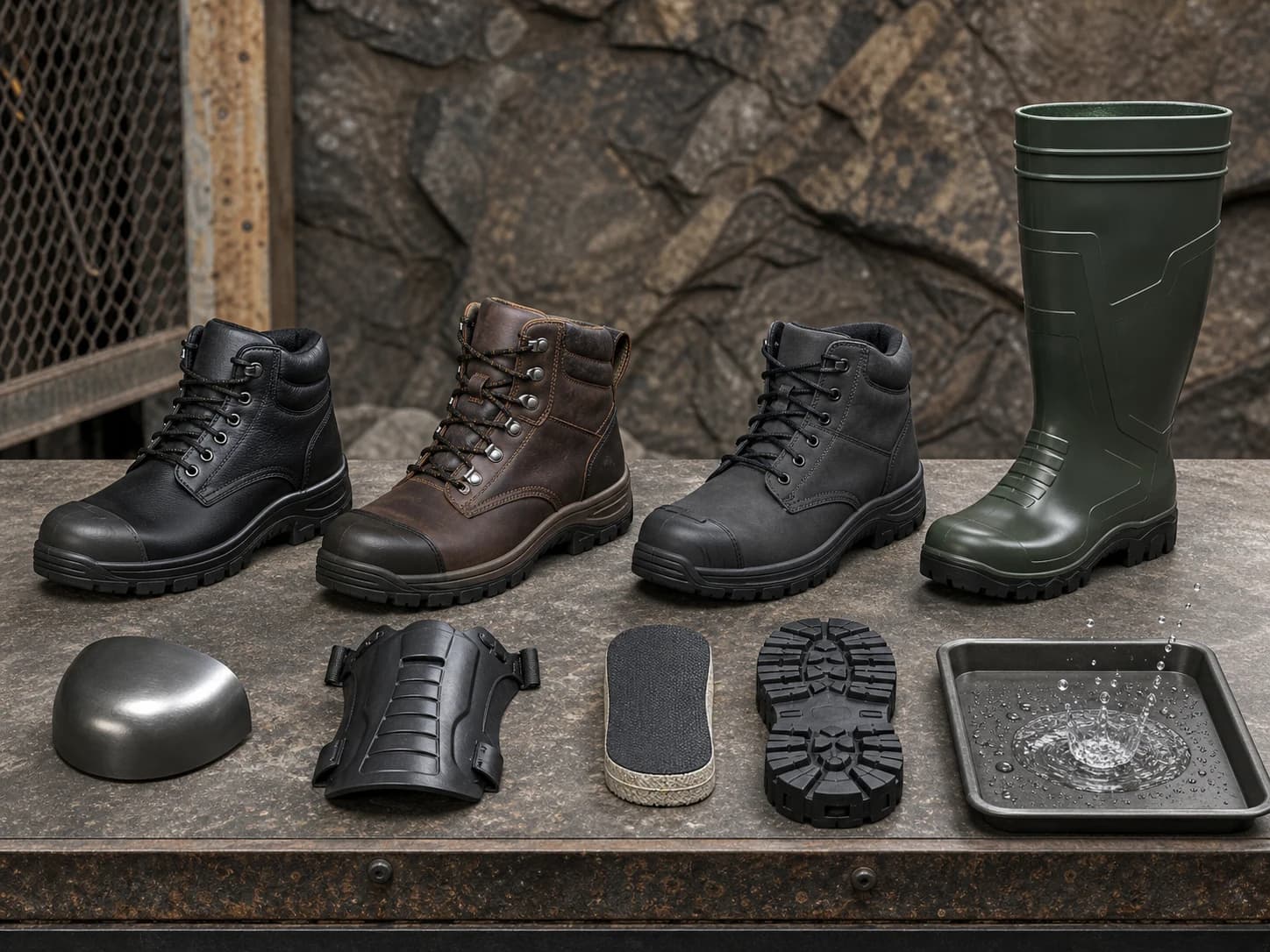
Compare Boot Protection Features Separately
A feature in one part of a boot does not prove another feature elsewhere. ASTM F2413-24, for example, treats toe impact, toe compression, metatarsal, electrical, static, puncture, chainsaw, and dielectric performance as distinct requirements. Its own scope also warns that laboratory tests do not establish performance for every field condition. Buyers therefore need the exact marking and supporting model documentation, not a chain of assumptions.
| Decision | Hazard question | What the buyer should verify | What not to assume |
|---|---|---|---|
| Safety toe | Can tools, rocks, parts, pipe, wheels, or loads strike or compress the toes? | Complete-footwear marking, test basis, model identity, toe-box fit, and condition criteria | “Steel toe” alone does not prove a standard, rating, metatarsal protection, or puncture resistance |
| Metatarsal protection | Can a long or heavy object strike the top of the foot behind the toe cap? | Required top-of-foot performance, guard design, coverage, compatibility, mobility, and label evidence | A safety toe protects the toe area; it does not automatically protect the metatarsals |
| Puncture resistance | Are sharp rock, wire, scrap, drill steel fragments, nails, or other objects an underfoot hazard? | Puncture marking, insert construction, test evidence, flex and fit effects, inspection, and replacement rules | A thick-looking outsole or steel toe does not prove puncture performance |
| Slip and terrain | Are routes wet, muddy, oily, sloped, loose, uneven, grated, stair-heavy, or ladder-based? | Outsole pattern and compound, applicable slip evidence, heel and flex geometry, mud release, and a site trial on representative routes | A laboratory slip result cannot cover every mine surface, contaminant, slope, or wear condition |
| Waterproof or wet-work | Is the exposure rain, puddles, washdown, saturated mud, standing water, or prolonged immersion? | Whether the claim applies to the upper or complete boot, boot height, seam construction, ingress points, drying, cleaning, and sock system | “Water-resistant” and “waterproof” are not interchangeable, and neither proves chemical resistance |
| Electrical need | Is the concern electric shock, static dissipation, conductive footwear, or purpose-rated dielectric protection? | The electrical hazard assessment, exact category and standard, dry or wet limitations, complete-footwear evidence, and inspection method | Composite toe is not automatically electrical protection; steel toe does not by itself define the complete boot's electrical performance |
| Chemical need | Which reagent, fuel, oil, cleaner, slurry, concentration, temperature, and contact duration are expected? | Chemical-specific material compatibility, permeation or degradation data where applicable, seam and sole resistance, decontamination, and disposal rules | PVC, rubber, leather, or “oil resistant” language does not prove suitability for every chemical |
For wet and muddy work, compare the Safety Rain Boots category with standard Safety Boots. A taller waterproof boot may improve water and mud control but still needs the separately required toe, underfoot, outsole, electrical, or chemical evidence.
Match Safety Boots to the Mine or Quarry Work Area
Use work areas to organize the trial, but finalize each specification by task and hazard.
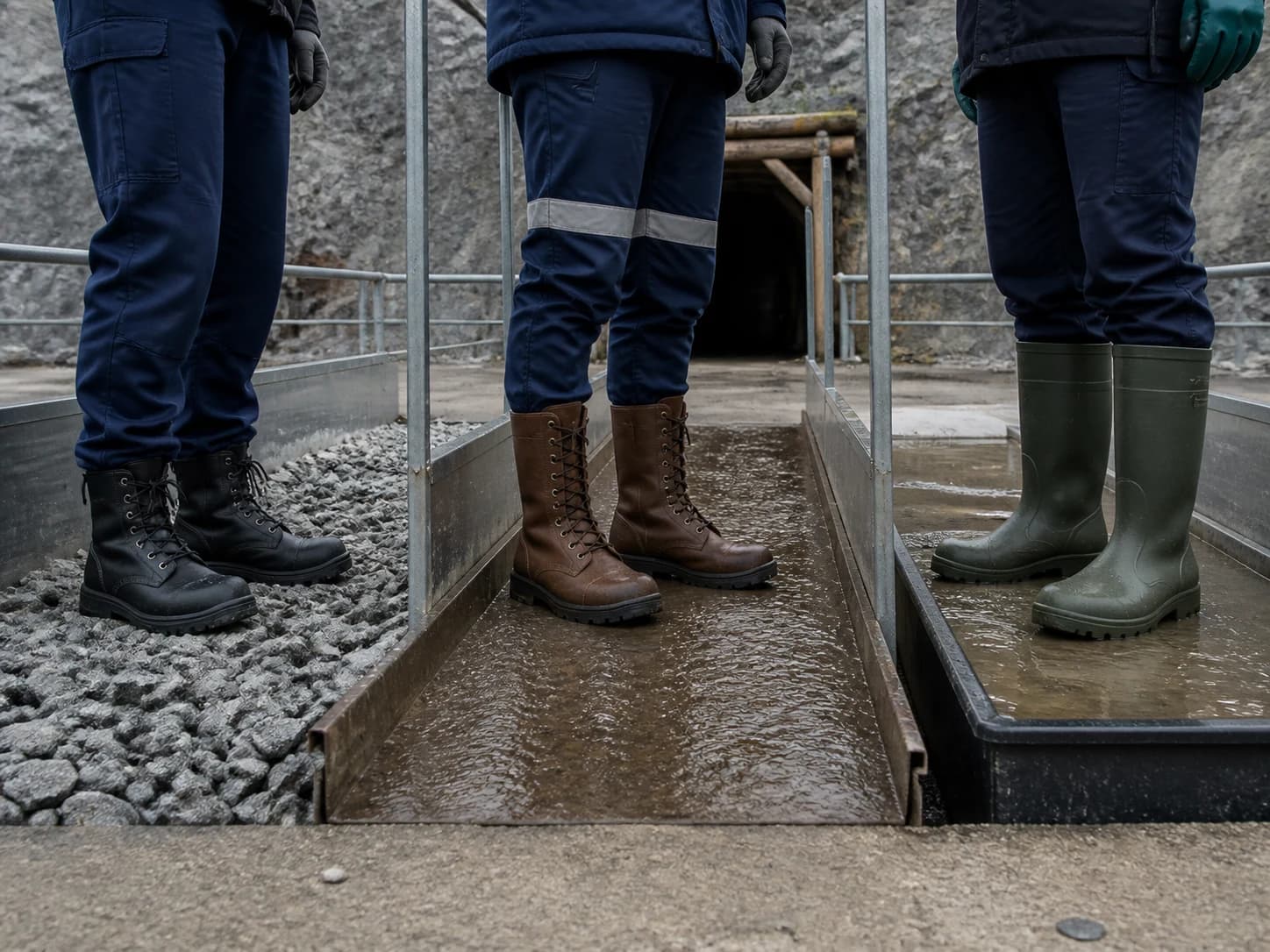
Open-pit routes and haul-road work
Workers leaving a cab may step onto loose rock, mud, ruts, stairs, ladders, fuel or oil residue, and uneven parking areas while exposed to mobile equipment. Verify tread behaviour, heel control, three-point access, pedal operation, visibility of the foot placement, weather management, and the ability to walk the actual inspection route. Footwear cannot replace safe parking, traffic separation, communication, road maintenance, or drainage.
Underground travelways and wet headings
Underground boots may need to manage persistent water, mud, low clearance, uneven ground, long walking distances, ladders, and emergency travel. Trial boot height and mass against walking endurance, ankle movement, kneeling, cap-lamp and trouser arrangements, and any site decontamination process. Do not turn “underground” into an automatic electrical, chemical, or waterproof rating; specify each required property from the site assessment.
Quarry benches, drilling, and crushing
Broken aggregate, sharp fragments, wet suppression, dust, steep access, steel stairs, and crusher spillage can combine toe, metatarsal, puncture, and slip concerns. Separate normal operation from cleanup, blockage response, sampling, and isolated maintenance. The Mining PPE Checklist by Task helps place footwear inside those wider control and PPE checks.
Processing and maintenance areas
Processing routes may add smooth wet floors, grating, reagents, oils, hot surfaces, sharp scrap, and heavy parts. Maintenance changes the risk again when workers grind, weld, open lines, handle components, or enter an isolated area. Select chemical, electrical, thermal, welding, or specialist footwear only through the relevant task procedure; a general mine boot should not be used as evidence that those specialist needs are covered.
The current LAIFAPPE catalog includes a PVC steel toe safety rain boot for mining and industrial work. Its verified catalog attributes are a waterproof PVC construction, steel toe, PVC upper/midsole/outsole, cotton-fabric lining, and unisex/all-season positioning. Treat it as a sourcing option only for those stated attributes. The current record does not establish a metatarsal, puncture, slip, electrical, chemical, ASTM, EN ISO, CSA, or other performance rating, so request and review any additional evidence before specifying it for those hazards.
Review Standards, Markings, and Model Documents
For U.S. surface metal and nonmetal mines, 30 CFR 56.15003 requires suitable protective footwear where a mine or plant foot-injury hazard exists. That short rule does not write the buyer's product specification. The mine still has to identify the hazard and determine what “suitable” means for the role, area, and conditions. Underground metal and nonmetal operations should verify the corresponding current Part 57 requirements and site rules.
For U.S. general-industry work that may occur outside mine jurisdiction, OSHA 29 CFR 1910.136 addresses falling or rolling objects, sole puncture, and residual electrical hazards after other protective measures. Do not copy an OSHA purchasing line into a mine RFQ without confirming which law and standard actually apply.
Use this document review:
| Document or marking | Buyer check |
|---|---|
| Applicable rule and standard | Country, jurisdiction, mine type, task, buyer contract, exact standard edition, and any equivalency route |
| ASTM route | If specified, confirm the exact model's ASTM F2413 marking and the separately required toe, metatarsal, puncture, electrical, static, or other properties; ASTM lists F2413-24 as active |
| ISO / EN route | Confirm the exact model, claimed category, additional markings, conformity documents, and certificate scope; ISO 20345:2021 is the published general-purpose safety-footwear standard and has a 2024 amendment |
| Special risks | Electrical insulating, chemical, chainsaw, molten-metal, fire, and other special risks may use complementary standards; ISO explicitly separates several of these from general-purpose ISO 20345 scope |
| Product identity | Model number, factory, construction, materials, label photo, production lot or traceability, and whether the sample matches the quoted bulk model |
| Test and certificate evidence | Issuer or laboratory, report or certificate number, tested model, test date, standard edition, covered sizes or construction, result, limitations, and current validity where relevant |
| Instructions | Intended use, exclusions, cleaning, approved insoles or repairs, storage, inspection, end-of-life criteria, and user information language |
Do not accept a certificate for a similar boot, a toe-cap component report, or a marketing title as proof for the complete offered model. ASTM also notes that aftermarket footbeds, inserts, or resoling may invalidate the original marking, so control changes after model approval. The Safety Footwear Label Decoder can help buyers prepare questions, but the original label and documents remain the evidence.
Run a Fit, Size, and Wear Trial Before Bulk Approval
Fit is a protection and adoption issue. A boot that causes heel lift, toe contact, cramped width, unstable footing, or excessive fatigue may be worn incorrectly or rejected by the crew. A single sample size cannot validate the full order.
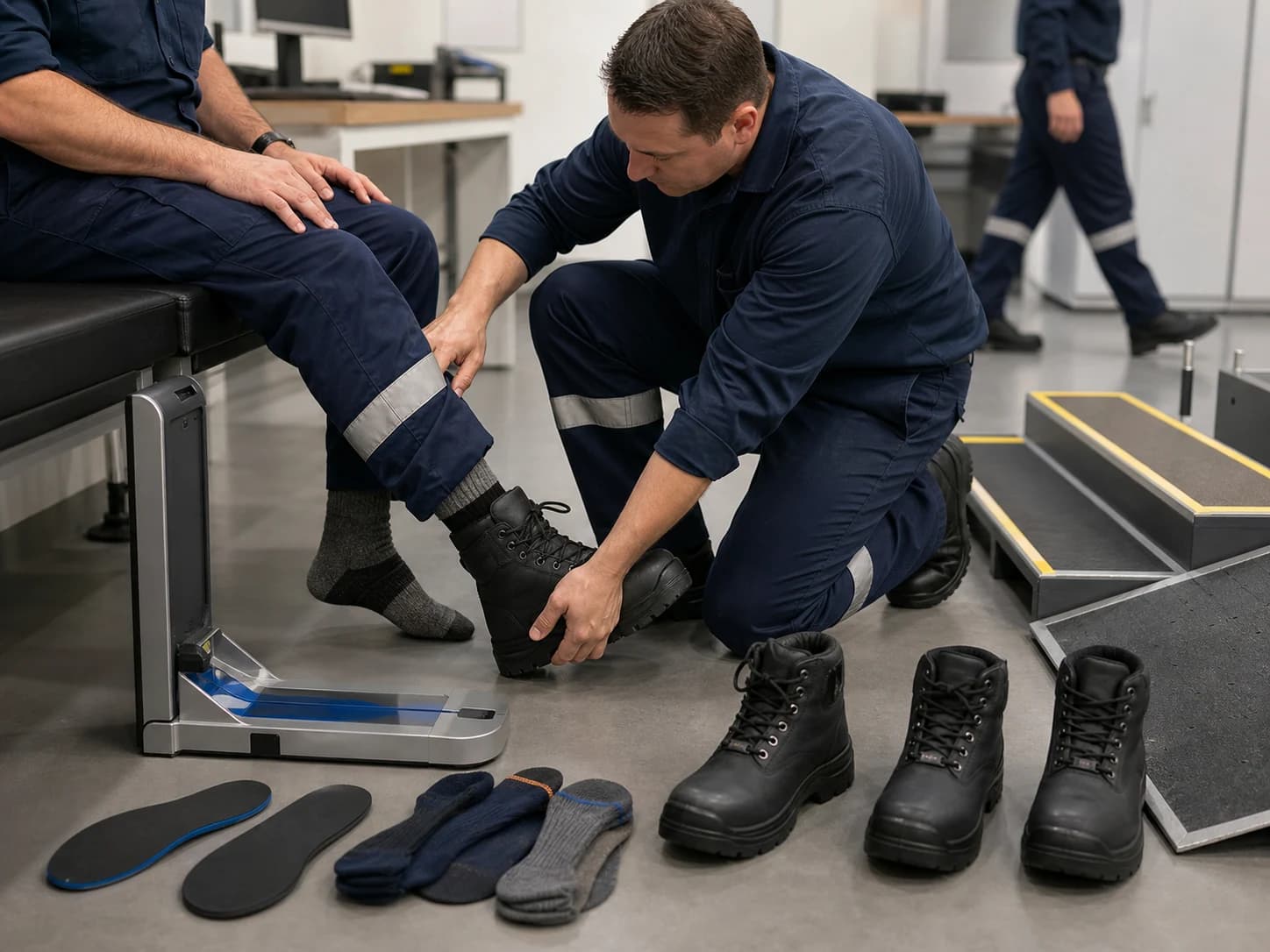
Build a representative trial group:
- Include different foot lengths, widths, volumes, and workers who normally need men's, women's, or other last shapes.
- Include the real work socks, orthoses or approved insoles, trousers, rainwear, gaiters, and any boot covers.
- Test at the start and later in the shift when feet may swell.
- Walk representative rock, mud, stairs, grating, slopes, ladders, and indoor surfaces under controlled conditions.
- Check vehicle pedals, steps, kneeling, crouching, climbing, and rapid but safe movement.
- Record heel retention, toe clearance, width pressure, ankle movement, hot spots, water entry, debris entry, grip feedback, fatigue, and donning time.
- Quarantine any sample that is damaged or contaminated during the trial; do not return it to issue stock without review.
Ask the supplier for an internal-length or manufacturer size chart rather than relying only on nominal EU, UK, US, or CN conversions. Use the Safety Boot Size Guide as a planning aid, then confirm the chosen model physically. Freeze the approved size curve and keep spare pairs around the real workforce distribution, not an equal quantity of every size.
Inspect, Clean, and Replace Boots by Condition
The mine should give workers a short pre-use check and supervisors a documented removal rule. Follow the manufacturer when its instructions are stricter.
Check before issue and use:
- outsole wear, cuts, splits, embedded material, exposed layers, separation, or loss of tread;
- upper cracks, punctures, swelling, hardening, chemical attack, failed seams, or water ingress;
- exposed or displaced protective components and any evidence of significant impact or compression;
- laces, zips, fasteners, pull loops, insoles, lining, heel retention, and contamination;
- label legibility and model identity where the site relies on a specific marking;
- unapproved repairs, resoling, inserts, or component substitutions; and
- fit changes, discomfort, numbness, blistering, or altered walking stability.
Remove the boot from service when a required protective or fit function is damaged, doubtful, no longer identifiable, or outside the manufacturer's criteria. Do not invent one calendar replacement interval for every mine. Track condition, hours or shifts where useful, task severity, contamination, cleaning, climate, incident exposure, and repeat defects. Bulk planning should include a controlled spare pool so workers do not keep unsuitable boots while waiting for the next shipment.
Write a Quote-Ready Mining Safety Boot RFQ
A useful RFQ lets the supplier answer with evidence rather than guess the mine's hazard assessment.
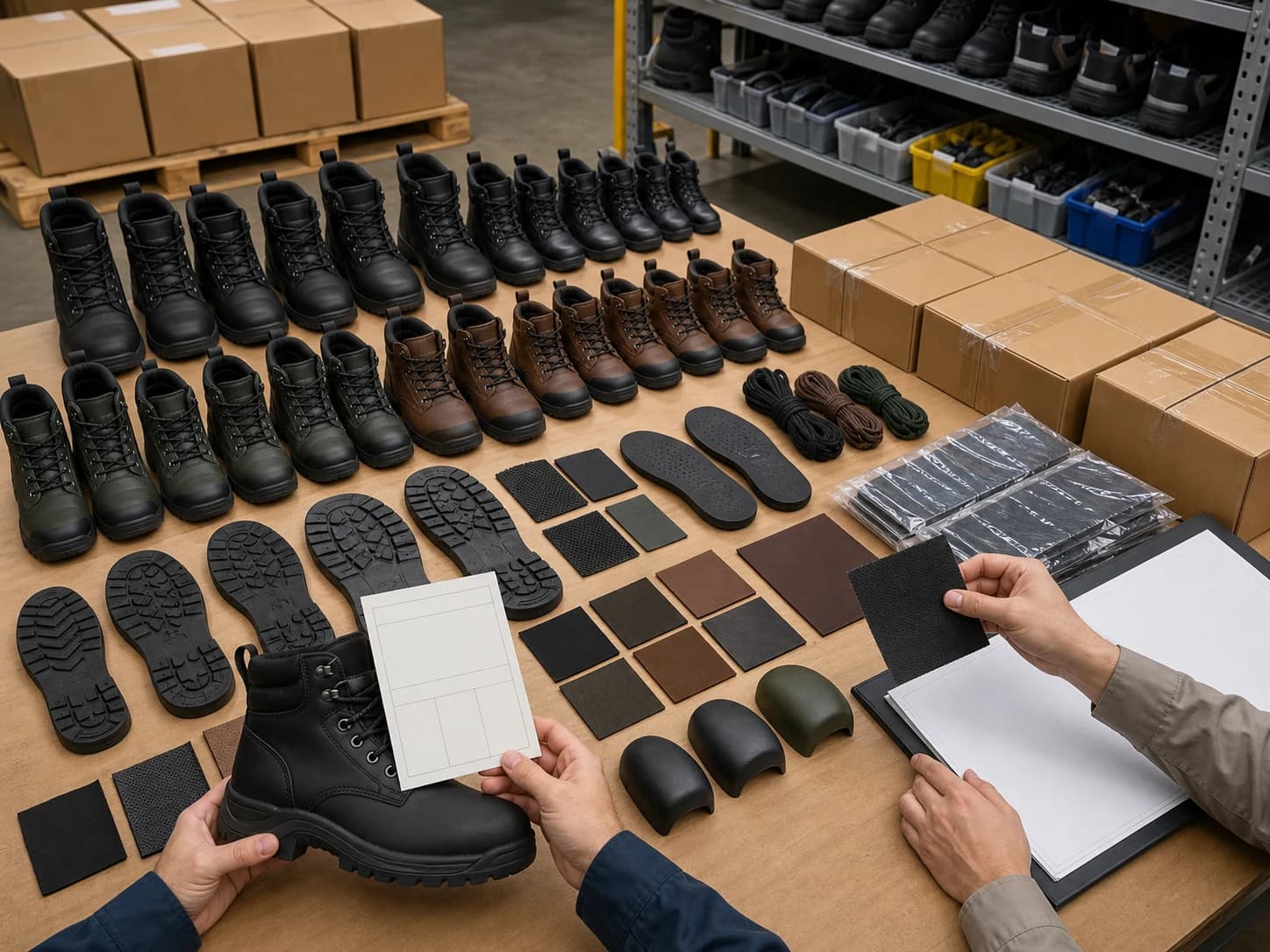
| RFQ field | What to provide or request |
|---|---|
| Site and scope | Country, mine or quarry type, surface or underground areas, workforce, contractors, delivery locations, and planned issue date |
| Role and task matrix | Role, work area, routine task, maintenance task, walking route, shift length, vehicle or ladder use, and control status |
| Hazard specification | Toe impact/compression, metatarsal, puncture, slip/terrain, water, mud, electrical, static, chemical, heat, cold, hygiene, and any specialist risk |
| Standards | Applicable regulation, standard and edition, required marking or category, buyer-specific acceptance, and evidence required for each property |
| Construction | Boot type and height, upper, lining, outsole, toe system, puncture system, metatarsal design, fastening, color, and cleaning needs without prescribing unsupported features |
| Fit and sizes | Size system, length and width range, last options, socks and approved insoles, trial sizes, workforce distribution, and spare-size policy |
| Documents | Data sheet, label and packaging photos, declaration, certificate or test references, instructions, traceability, material information, and limitations |
| Sample approval | Exact-model samples, evaluation roles, route and wear duration, scorecard, approval owner, retained reference sample, and change-control rule |
| Commercial response | MOQ by model and size, price basis, sample cost, lead time, packaging, shipment plan, defect process, reorder quantities, and substitution policy |
| Lifecycle | Inspection criteria, cleaning, storage, replacement parts if any, repair limits, warranty, end-of-life guidance, and replacement-stock assumptions |
Use the PPE Quantity Calculator for issue and replacement assumptions, the PPE Size & Standards Planning Sheet for the size curve, and the AI Quote Generator to organize the reviewed brief. Keep the supplier's offered features clearly separated from the mine's final acceptance decision.
Common Mining Boot Buying Mistakes
- Buying the product name. “Mining boot,” “safety boot,” or “steel toe” is not a complete performance specification.
- Treating toe protection as full-foot protection. Metatarsal and puncture needs require separate assessment and evidence.
- Using one boot for every area. Wet headings, haul routes, crusher stairs, workshops, and reagent areas can need different controlled variants.
- Assuming material equals rating. Steel, composite, PVC, rubber, and leather describe construction; they do not automatically prove electrical, chemical, puncture, slip, or standard performance.
- Copying a standard code without the edition or marking. State which requirement applies and what evidence the supplier must return.
- Skipping a route trial. A tabletop sample review will not show heel lift on stairs, mud release, pedal interference, or late-shift fit.
- Ordering only core sizes. A bulk order fails if part of the workforce cannot obtain a correctly fitting approved pair.
- Allowing silent substitutions. A change in outsole, toe cap, insert, upper, factory, or insole can change fit and performance evidence.
- Setting replacement by price alone. Include inspection, cleaning, lead time, spare stock, and defect trends in lifecycle cost.
- Using PPE to accept bad access. Boots do not correct spillage, broken stairs, poor drainage, uncontrolled traffic, or missing isolation.
Buyer Approval Checklist
Before approving the purchase, confirm:
- [ ] Each role and work area has a recorded foot-hazard basis.
- [ ] Control gaps are assigned separately from the footwear order.
- [ ] Toe, metatarsal, puncture, slip/terrain, wet-work, electrical, and chemical decisions are explicit rather than inferred.
- [ ] The applicable regulation, standard, edition, and site rule are recorded.
- [ ] Every claimed property maps to the exact offered model and supporting evidence.
- [ ] Representative workers completed a documented size and wear trial.
- [ ] The size curve covers actual foot lengths, widths, and approved fit options.
- [ ] The supplier may not substitute construction or model details without written re-review.
- [ ] Pre-use inspection, quarantine, cleaning, and replacement rules are ready.
- [ ] Spare sizes, reorder points, lead times, and repeat-order traceability are included.
Frequently Asked Questions
Are steel toe boots enough for mining and quarry work?
Not necessarily. A steel toe addresses only the stated toe construction unless the complete boot has additional verified markings. The hazard assessment may also identify metatarsal, puncture, outsole, wet-work, electrical, chemical, temperature, or fit requirements. Verify each property separately.
Do quarry workers always need puncture-resistant boots?
There is no universal answer based only on the word “quarry.” Assess the actual routes, sharp rock, scrap, wire, maintenance debris, cleanup conditions, and controls. If underfoot puncture is a hazard, specify and verify the required puncture performance for the complete model.
Are waterproof PVC rain boots suitable for every wet mine area?
No. Waterproof PVC construction can be useful for water and mud, but the buyer still needs to check fit, grip, terrain, toe and underfoot hazards, chemicals, temperature, electrical conditions, walking duration, and the exact product evidence. Waterproofing does not establish those other properties.
Should a mine buy one boot model or several?
Use the smallest controlled set that covers the assessed roles without forcing incompatible requirements into one heavy boot. Many sites may need a core rough-terrain boot, a wet-work boot, and separately controlled specialist footwear, but the site assessment and trial should determine the final number.
What documents should be requested before a bulk order?
Request the exact-model data sheet, label and packaging photos, standard and marking details, certificate or test references where applicable, user instructions, material and traceability information, size chart, limitations, cleaning and replacement guidance, and written confirmation that bulk production matches the approved sample.
How many samples are needed for a mining boot trial?
Do not use one fixed number. Choose enough sizes, widths, workers, roles, routes, and shifts to test the real fit distribution and operating conditions. Include edge sizes and the workers most likely to be missed by a standard size curve.
Related Mining Guides and Sources
Pair the footwear brief with the Mining Work Gloves for Maintenance and Material Handling guide when planning task-specific hand protection, size trials and replacement stock for the same crew.
- Mining Safety Equipment and PPE for Quarry Operations
- Mining PPE Checklist by Task
- Open-Pit vs Underground Mining PPE
- Mining Hearing Protection Guide
- Mining Silica Dust Controls and Respirator Selection
- OSHA Foot Protection Selection Guide
- ASTM F2413-24
- ISO 20345:2021
Need a review-ready mining or quarry safety boot shortlist? Send the work-area and role matrix, hazards, required standards and documents, size distribution, sample-trial plan, quantity, delivery country, and replacement assumptions through the quote request. LAIFAPPE can organize available footwear and document options for buyer review; the mine or quarry operator remains responsible for the hazard assessment, applicable rules, final selection, fit, issue, training, inspection, and use.
Primary sources reviewed: current eCFR 30 CFR 56.15003; OSHA 29 CFR 1910.136 and OSHA foot-protection selection guidance; ASTM's active F2413-24 scope; and ISO's published ISO 20345:2021 page with Amendment 1:2024. Verify current jurisdiction-specific requirements and the exact offered-model evidence before purchase.
Related PPE
Source the PPE covered in this guide
Move from research to a buyer shortlist with the matching solution page, category paths, selected PPE options, and RFQ next steps.