Order overview
| Product | Quantity | Unit |
|---|---|---|
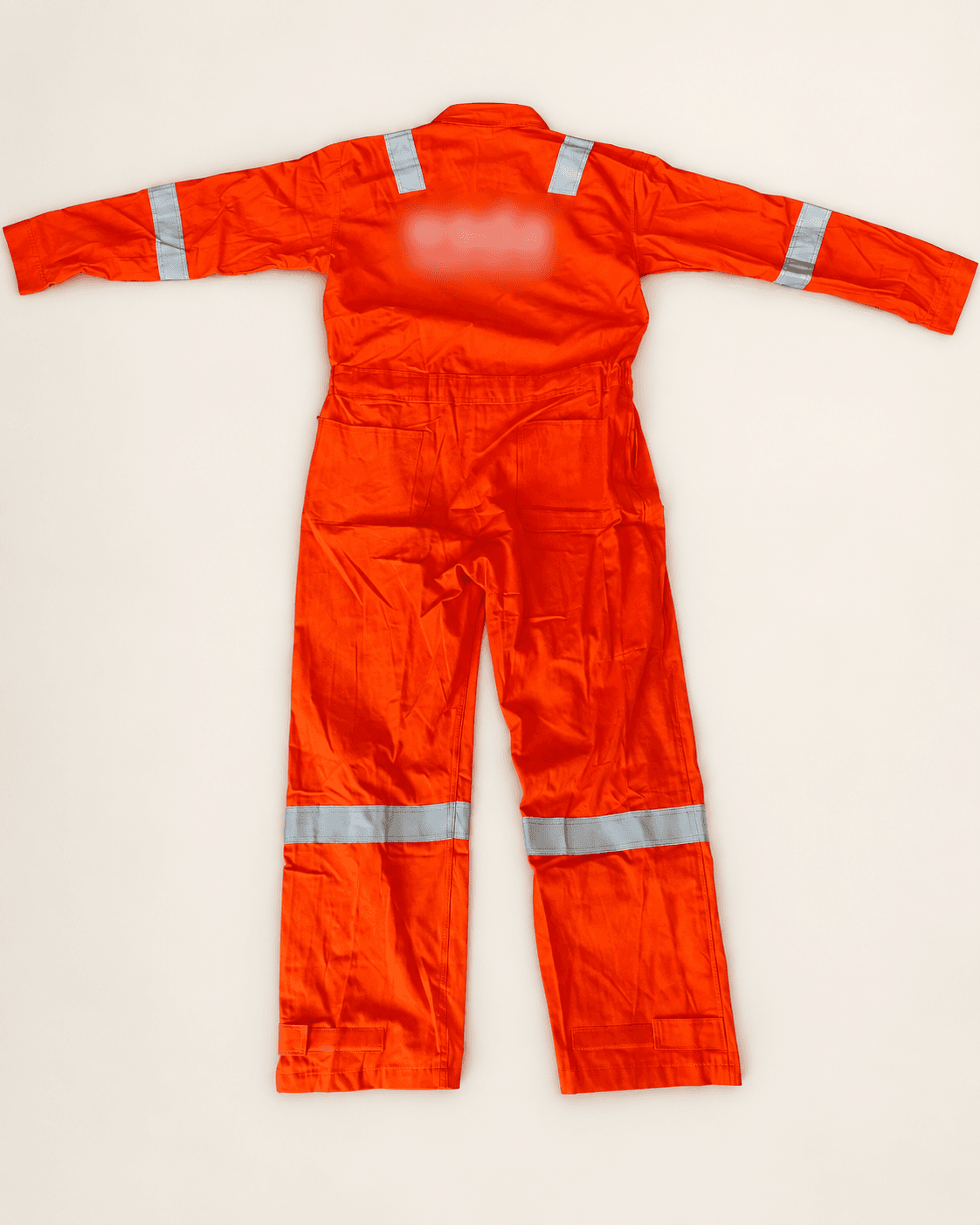
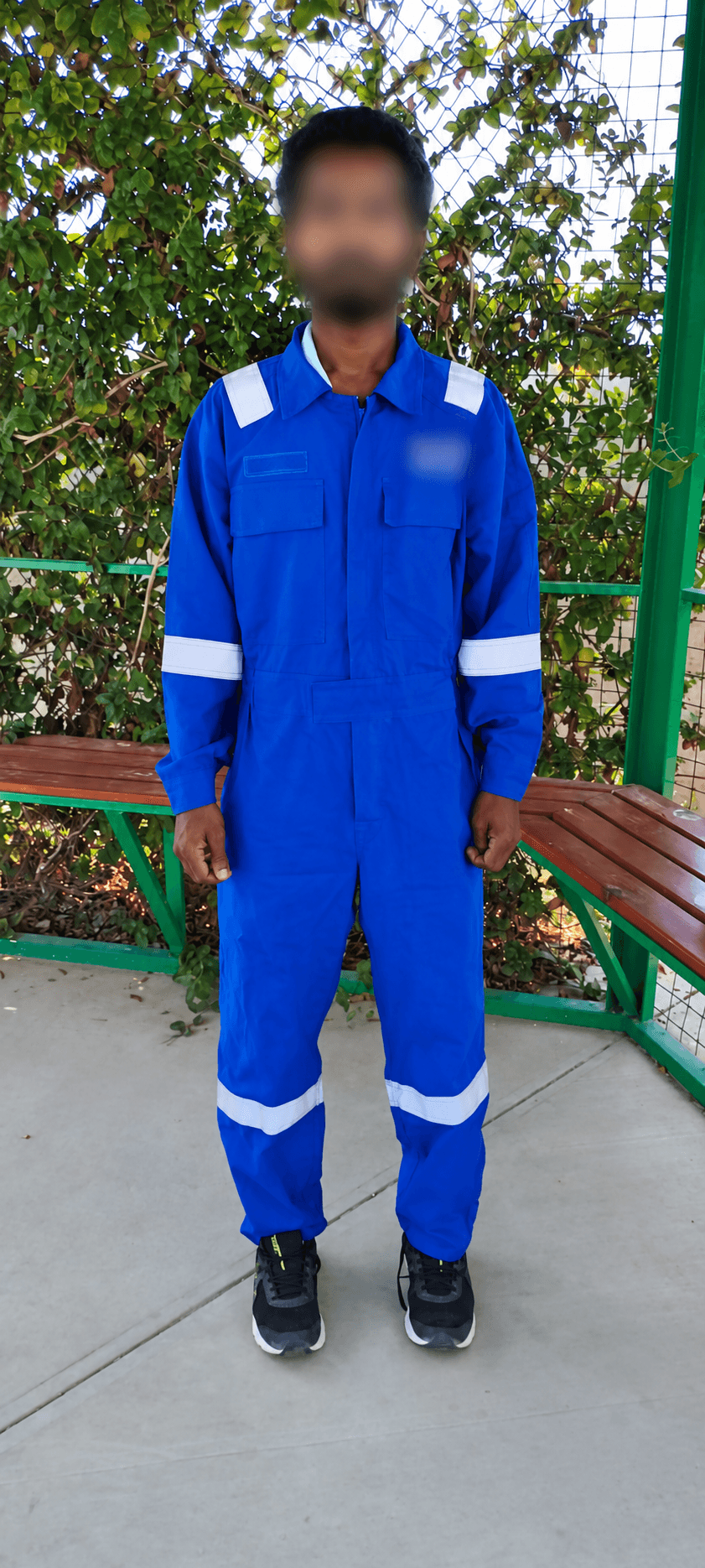
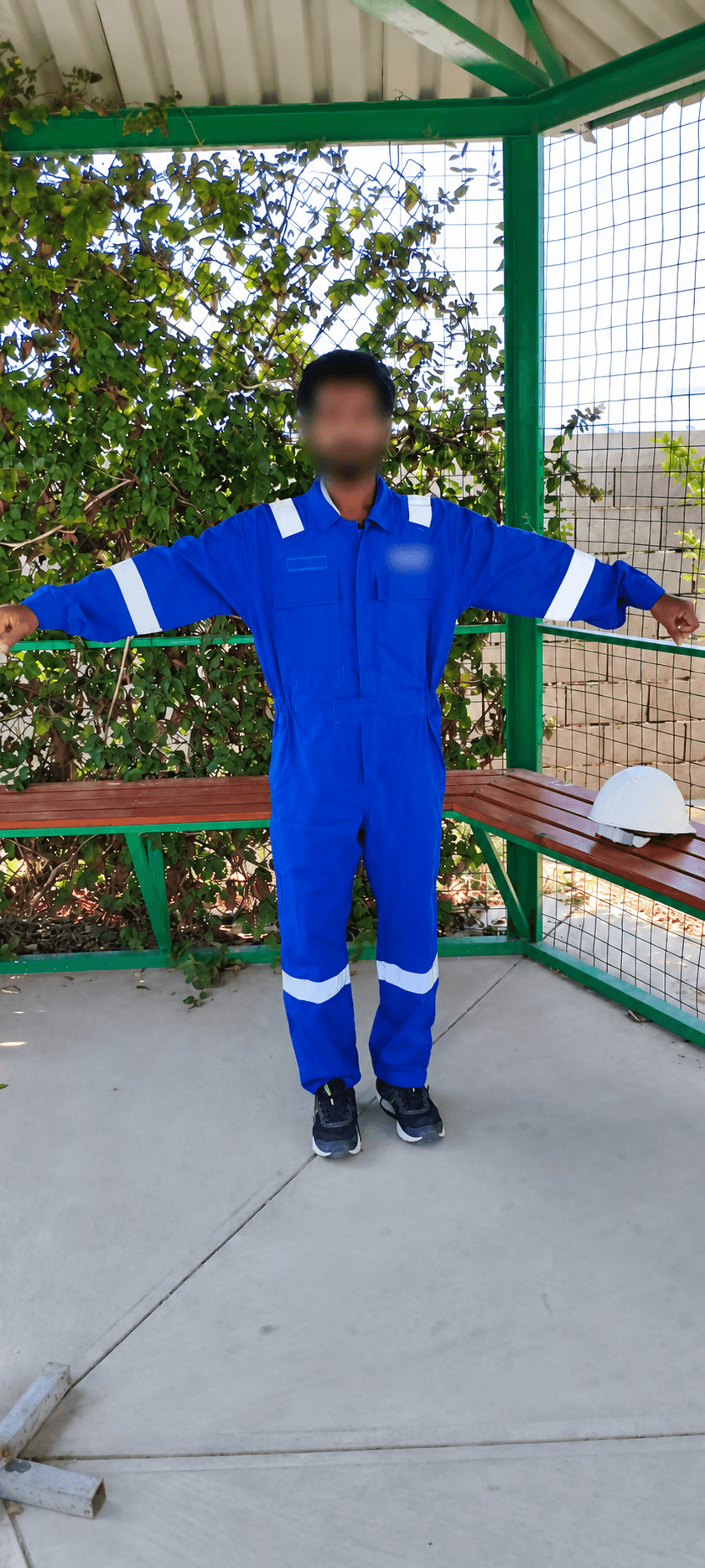
| 01Blue reflective coveralls | 490 | garments |
| 02Orange reflective coveralls | 510 | garments |
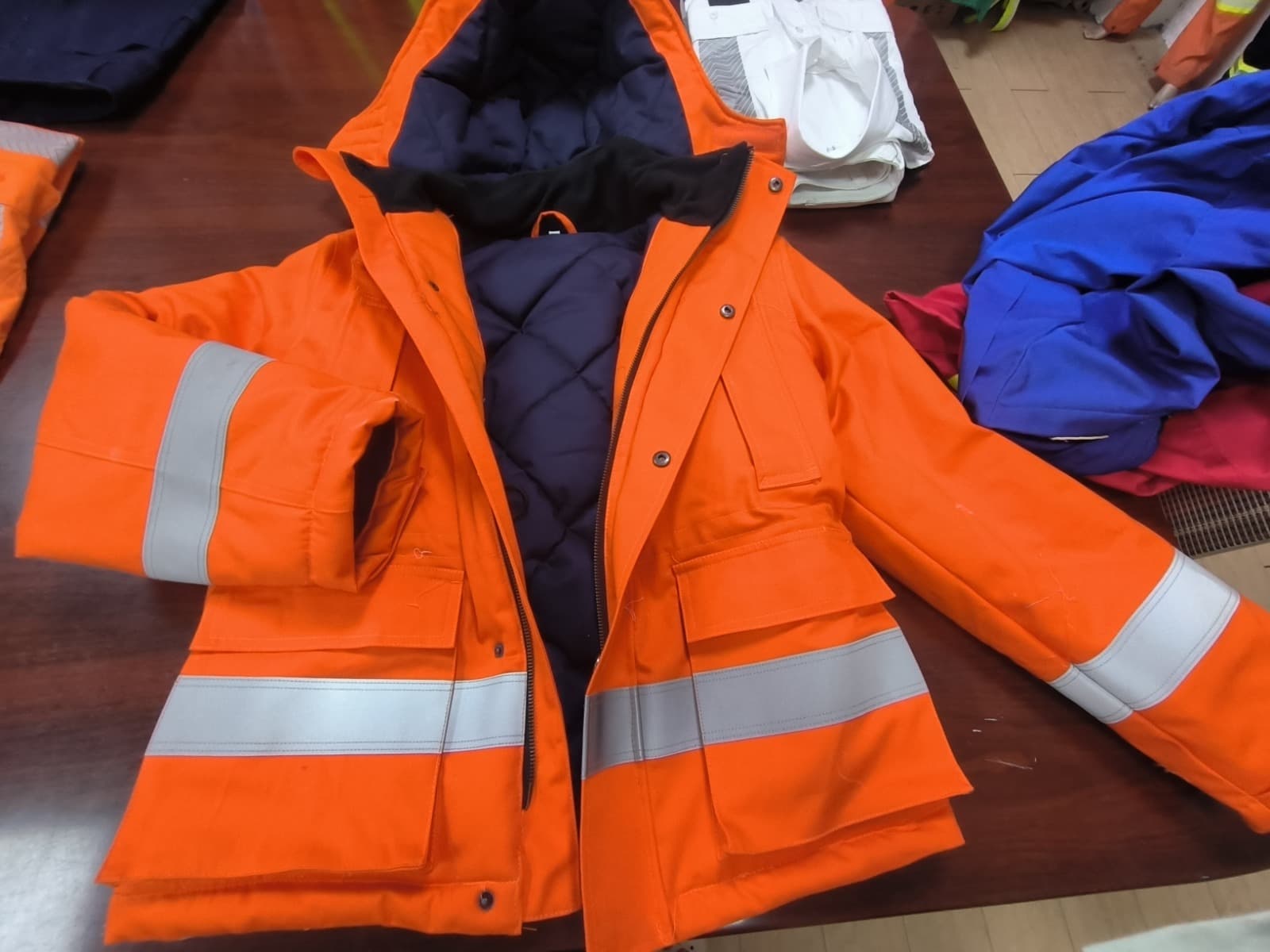
| 03Orange winter jackets | 310 | garments |
| 04White safety helmets | 500 | helmets |
| 05Safety eyewear | 500 | pairs |
| 06PU-coated gloves | 100 | pairs |
Quantities and units are specific to this procurement record.
Discuss your product listThe procurement brief
A Central Asian oil company sourcing workwear and PPE. Project status: Delivered.
Project snapshot: the customer, the order and the result
A Central Asian oil company needed an alternative purchasing proposal for a mixed workwear and PPE order. The brief covered blue and orange coveralls, insulated winter jackets, safety helmets, eyewear and gloves. Alongside the cost target, the customer needed the right garment quantities, a defined size mix and company branding suited to each product.
YUELAIFA completed and delivered a program of 1,310 garments plus accompanying PPE. Procurement costs were 80% lower than the customer’s previous supplier quotation. The case follows the purchasing decisions behind that delivered configuration: defining the order, allocating sizes, specifying the winter jacket and adapting branding across the range.
The winter jackets accounted for 310 garments and had their own construction requirements. The customer’s previously purchased winter model was Portwest FR59, described later in this case. The remaining 1,000 garments were coveralls in two colors. Keeping these requirements distinct helped the customer review the alternative offer at product level, with the actual configuration visible alongside the price.
The challenge: a lower price for a detailed purchasing requirement
The purchasing question was practical: how could the customer reduce the quoted procurement cost while keeping a multi-product order clearly specified? The range contained different units of purchase, unequal color quantities and separate winter-jacket requirements. A single total price or a single reference photograph could not express all of those decisions.
Reduce the existing quotation cost — Project response: Prepare an alternative supply proposal; What the buyer could review: 80% lower procurement costs against the previous supplier quotation.
Match color and size demand — Project response: Keep three garment lines and six size groups separate; What the buyer could review: 490 blue coveralls, 510 orange coveralls and 310 winter jackets.
Define the winter jacket in detail — Project response: Specify pockets, closures, adjustment points and inner construction; What the buyer could review: The features and dimensions behind the outerwear reference.
Carry one company identity across the range — Project response: Set branding method and placement by product; What the buyer could review: Printing, embroidery and surface-specific logo positions.
These requirements shaped the product configuration described below. The delivered result brings that configuration together with the procurement-cost comparison.
1. Define the product mix before comparing the offer
The order covered five product categories and six purchasing lines, because the blue and orange coveralls required separate quantities. The garment total was useful for understanding scale, but production and purchasing needed the detail beneath it. Helmets were counted individually; eyewear and gloves were ordered in pairs.
Blue reflective coveralls — Quantity: 490 garments.
Orange reflective coveralls — Quantity: 510 garments.
Orange winter jackets — Quantity: 310 garments.
White safety helmets — Quantity: 500 helmets.
Safety eyewear — Quantity: 500 pairs.
PU-coated gloves — Quantity: 100 pairs.
The winter jacket was treated as a separate garment with its own construction brief and size allocation. The PPE quantities also remained independent: 500 helmets, 500 pairs of eyewear and 100 pairs of gloves. This was a mixed procurement program, so the quantities were not forced into a uniform number of complete wearer kits.
For a buyer comparing proposals, this level of detail establishes what each offer actually includes. Product description, quantity, unit, color and customization belong on the same purchasing schedule. A lower total becomes more useful when the buyer can also see the configuration to which it applies.
2. Preserve the customer’s color and size allocation
The coverall color split was close to even, but the difference mattered. Supplying 500 blue and 500 orange coveralls would still total 1,000 garments while leaving ten too many blue and ten too few orange against the requested allocation. The same issue appeared within sizes: blue XL required 130 garments, while orange XL required 150.
We retained a separate S-to-3XL schedule for each garment line. Three lines across six size groups created 18 garment-and-size allocations, making both the individual requirements and the overall totals visible.
Blue coveralls — S: 10; M: 20; L: 90; XL: 130; 2XL: 130; 3XL: 110; Total: 490.
Orange coveralls — S: 10; M: 20; L: 90; XL: 150; 2XL: 130; 3XL: 110; Total: 510.
Winter jackets — S: 10; M: 20; L: 40; XL: 90; 2XL: 80; 3XL: 70; Total: 310.
All garments — S: 30; M: 60; L: 220; XL: 370; 2XL: 340; 3XL: 290; Total: 1,310.
XL through 3XL represented 1,000 garments, or 76.3% of this order. That concentration reinforced the need to work from the customer’s allocation. It was a project-specific distribution, rather than a generic size assortment.
The winter-jacket specification also defined physical garment measurements. XL called for a 74.5 cm back length, 49.5 cm shoulder width, 126 cm full chest measurement and 68.5 cm sleeve length. For 3XL, the full chest measurement was 134 cm and sleeve length was 71.5 cm. These specified garment dimensions gave the size labels a concrete reference for production and review.
The customer’s previous winter jacket reference
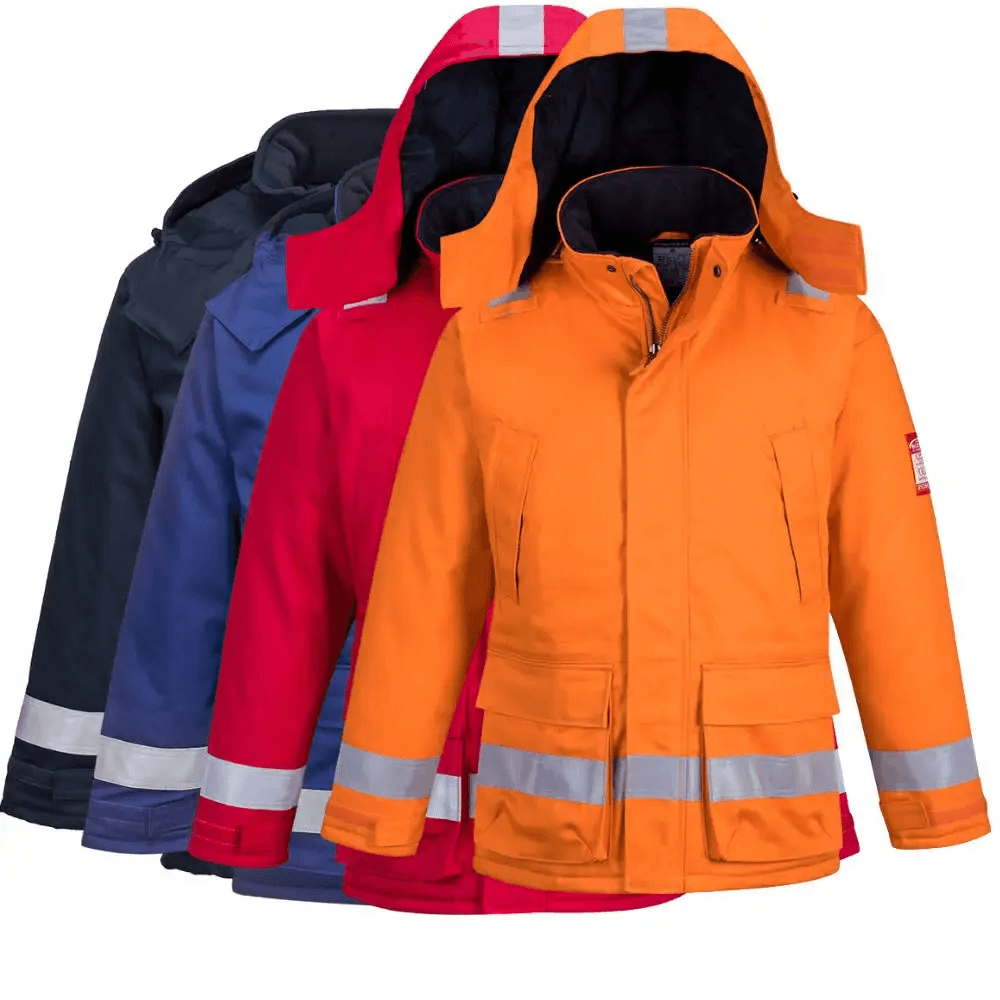
The customer had previously purchased Portwest FR59 winter jackets. That purchasing history gives the winter-workwear requirement a specific point of reference: an insulated industrial jacket with defined protective materials, reflective detailing and practical storage. For a purchasing team reviewing an alternative offer, the familiar model provides a useful starting point for separating material requirements from fit, construction and branding decisions.
Portwest’s current FR59 product information distinguishes the outer fabric, lining and insulating fill. It identifies flame-retardant materials in all three layers:
Outer fabric — Portwest FR59 published material specification: Bizflame Work: 99% cotton and 1% carbon fibre, flame-retardant fabric.
Lining — Portwest FR59 published material specification: 100% cotton, flame-retardant lining.
Insulating fill — Portwest FR59 published material specification: 100% polyester, flame-retardant filling.
These specifications describe the FR59 reference model. They do not establish matching certification or protective performance for the jacket supplied in this project.
Source: Portwest FR59 product information: https://www.portwest.com/products/view/FR59/ORR (opens in a new tab)
Reference: FR59 technical datasheet dated 13 January 2025: https://docs.rs-online.com/4ccd/A700000012659833.pdf (opens in a new tab)
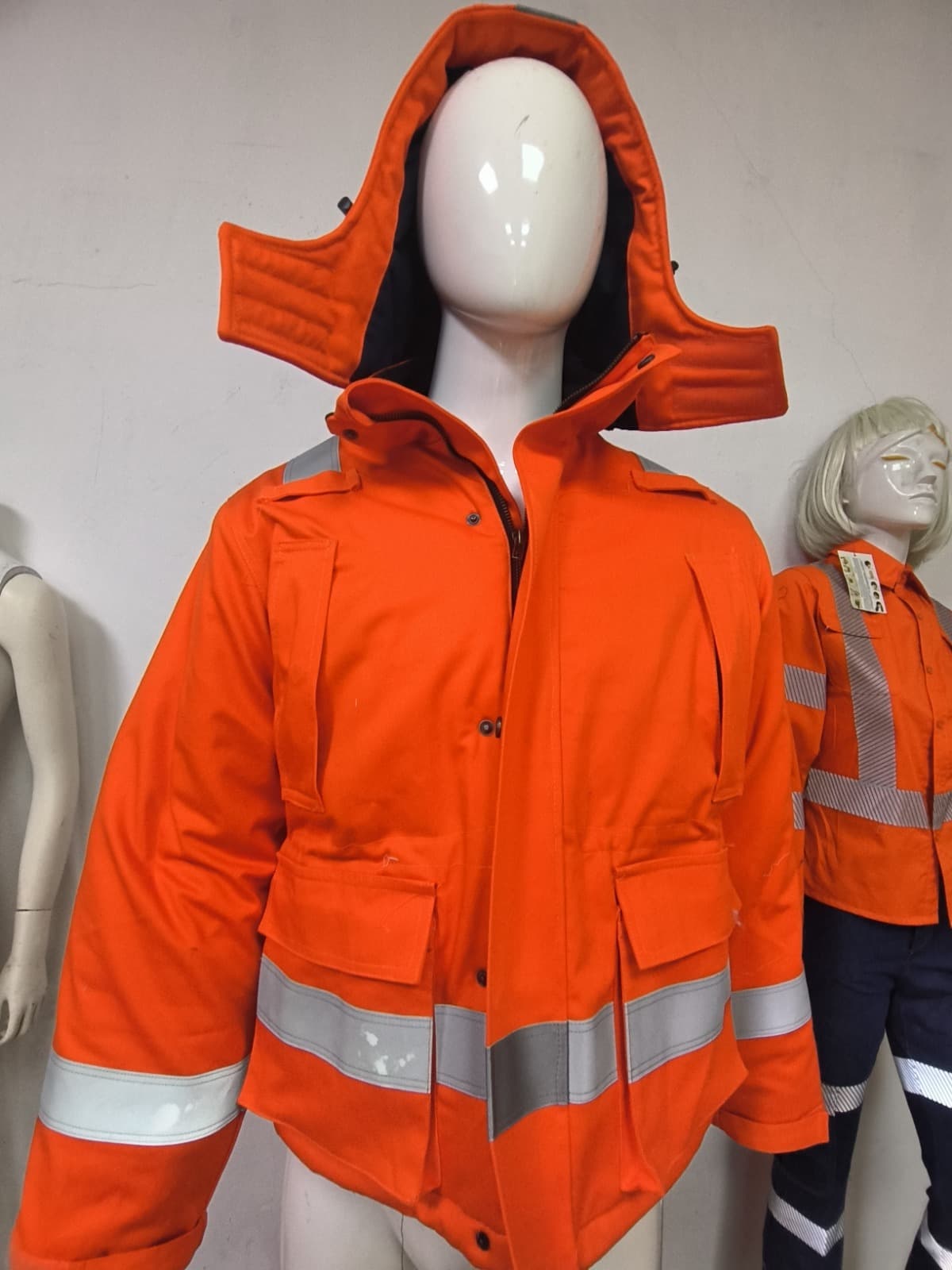
YUELAIFA’s winter-jacket brief specified flame-retardant outer fabric and linings, with insulation treated as a separate component. It also recorded garment measurements, pocket and closure details, adjustment points, reflective-tape placement and customer branding. Breaking the requirement into these elements made the proposal more specific than a request for a similar-looking coat. The following project photographs show the actual garment and its construction details.
3. Translate the winter-jacket reference into usable features
For the 310 insulated jackets, the discussion went beyond color and silhouette. Storage, equipment attachment, adjustment, front closure and inner construction each needed their own description. The production brief combined those details with the reflective-tape layout and garment measurements.
The five-pocket arrangement included chest storage, two lower patch pockets with hook-and-loop flaps, and an internal pocket. Pocket openings and closures were specified as well as the pocket count. Two radio loops above the chest areas provided defined equipment-attachment positions. Together, those details made the storage and attachment layout easier to assess.
The detachable hood, hook-and-loop cuffs and drawcord waist gave the garment separate adjustment points. The front closure was specified with a two-way brass zipper and five fixing fasteners. Addressing each component individually kept hood attachment, wrist adjustment, waist setting and front opening from being left to an overall style reference.
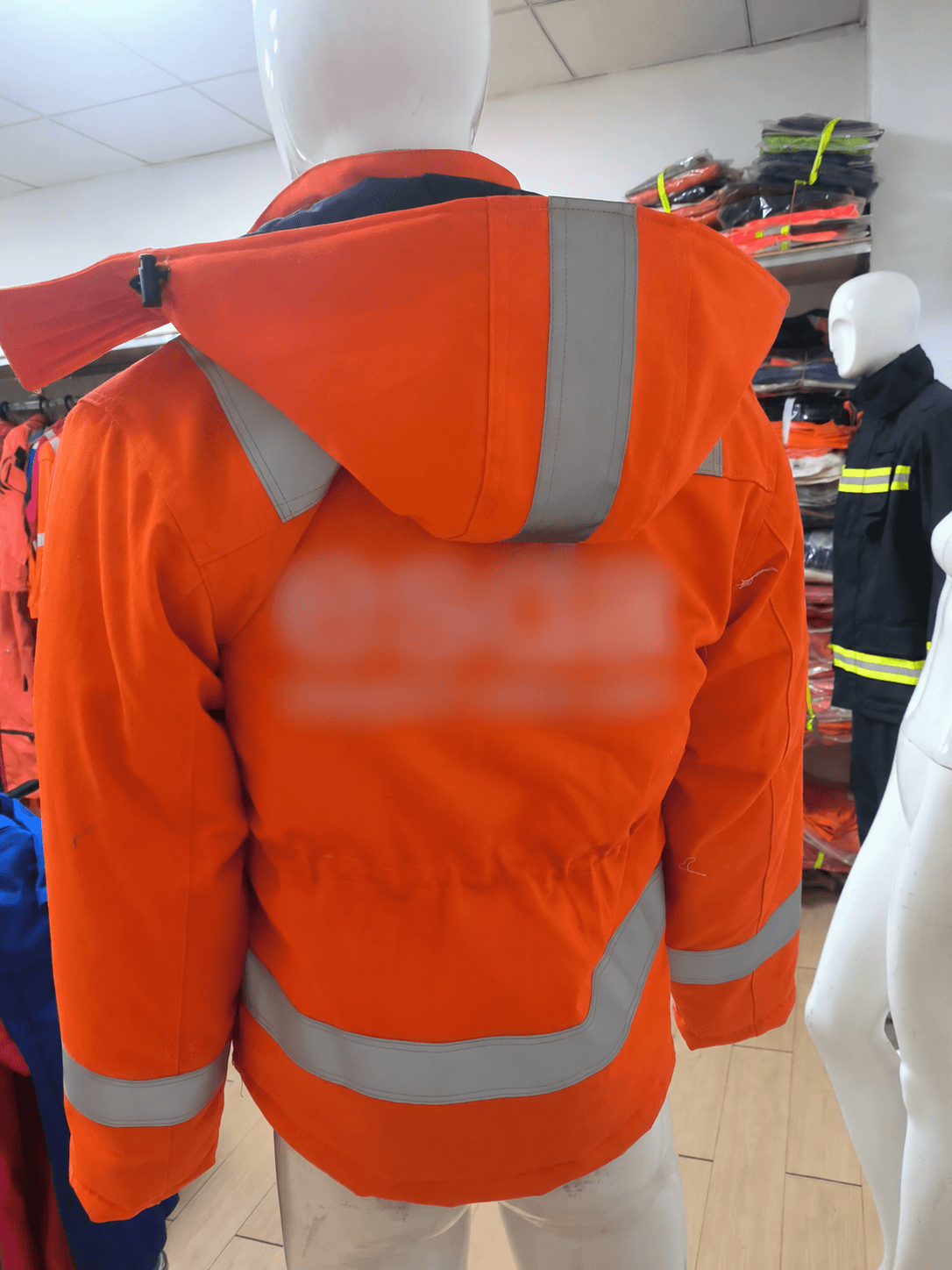
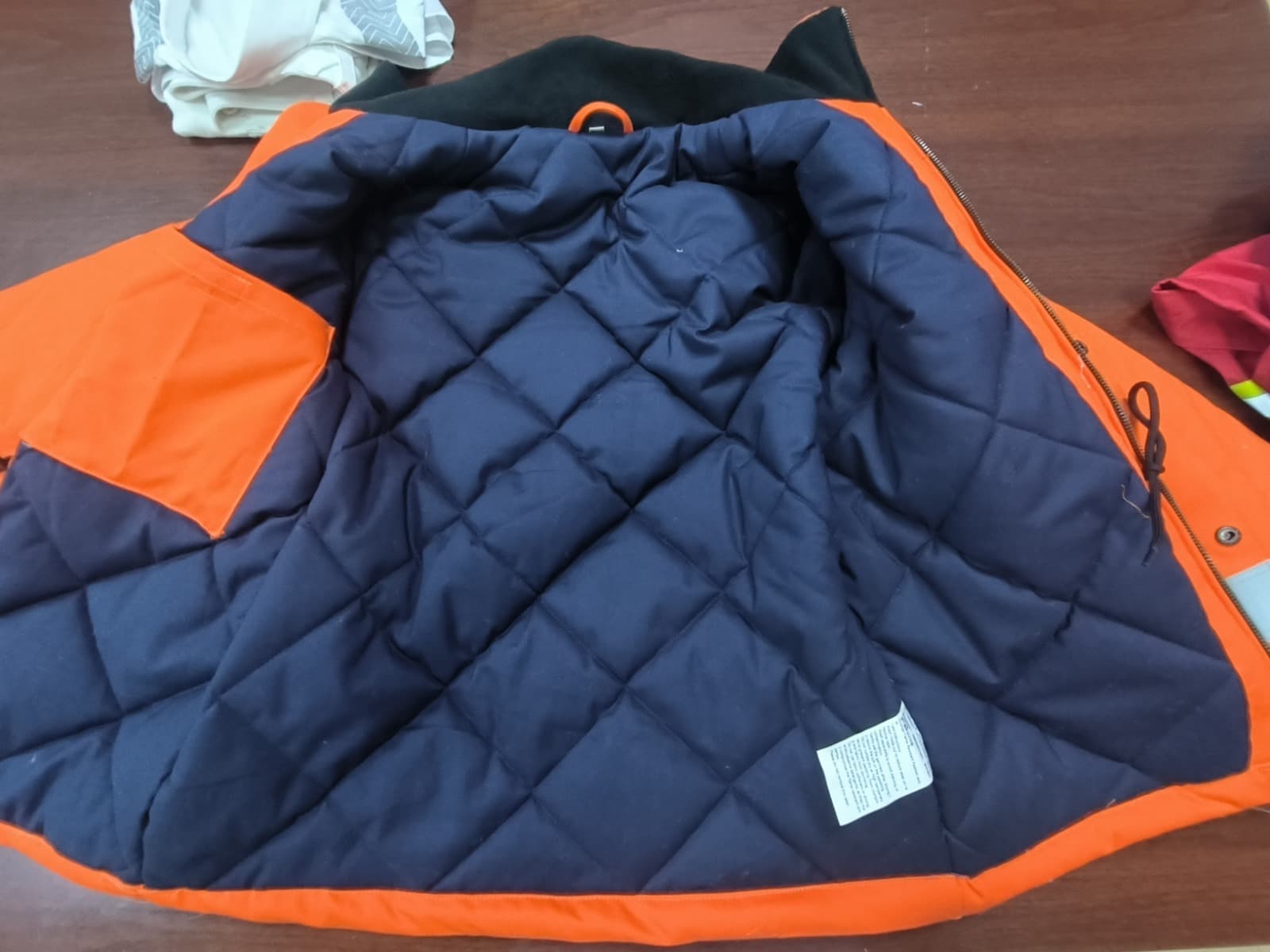
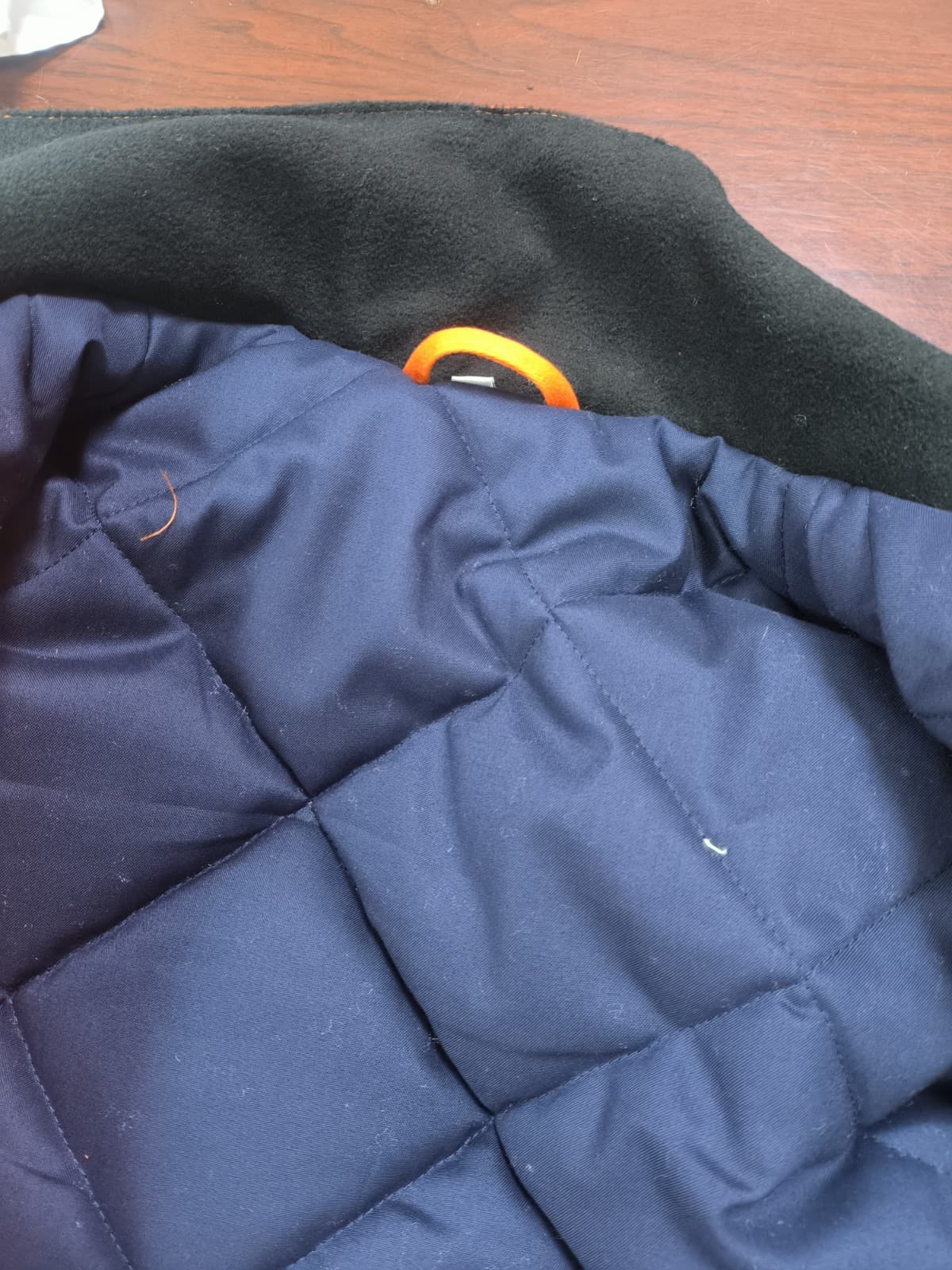
Inside, the photographed jacket shows dark diamond-quilted lining, a black fleece collar facing, an internal waist drawcord and a hanging loop. The shell, lining and filling were separate material decisions in the brief. This matters when reviewing an outerwear proposal: the inside construction is part of the garment requirement, even when the first product reference shows only its exterior.
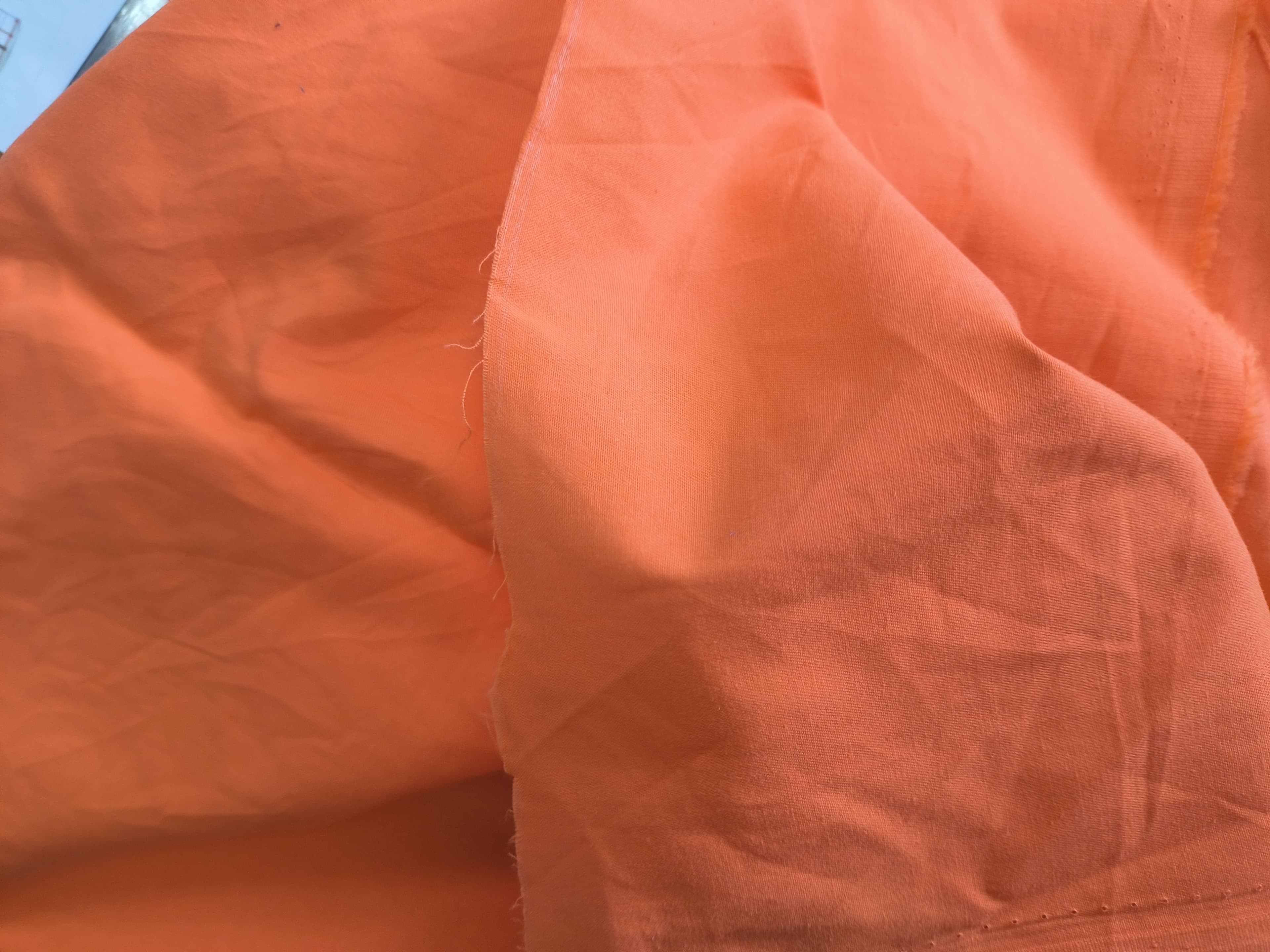
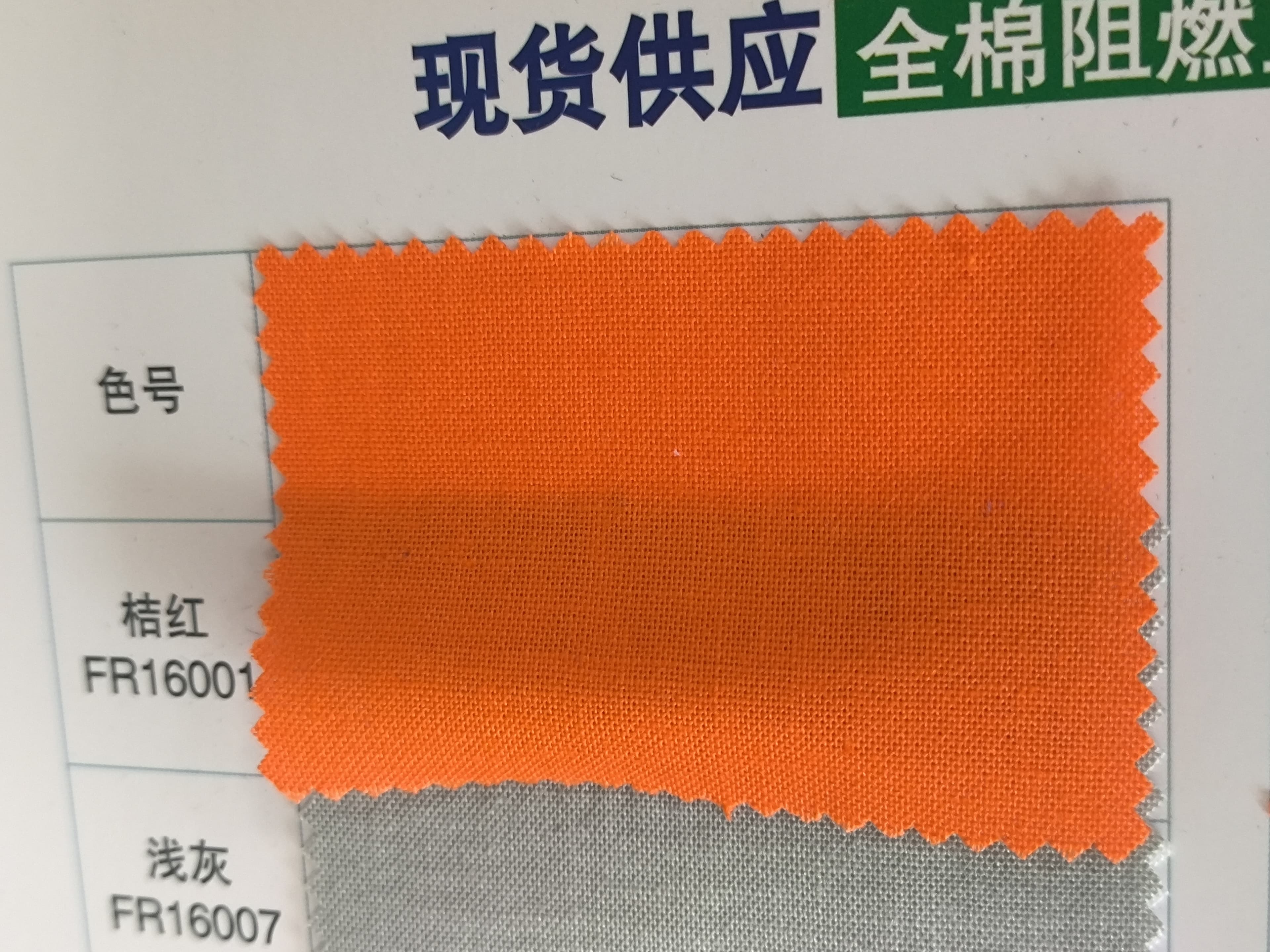
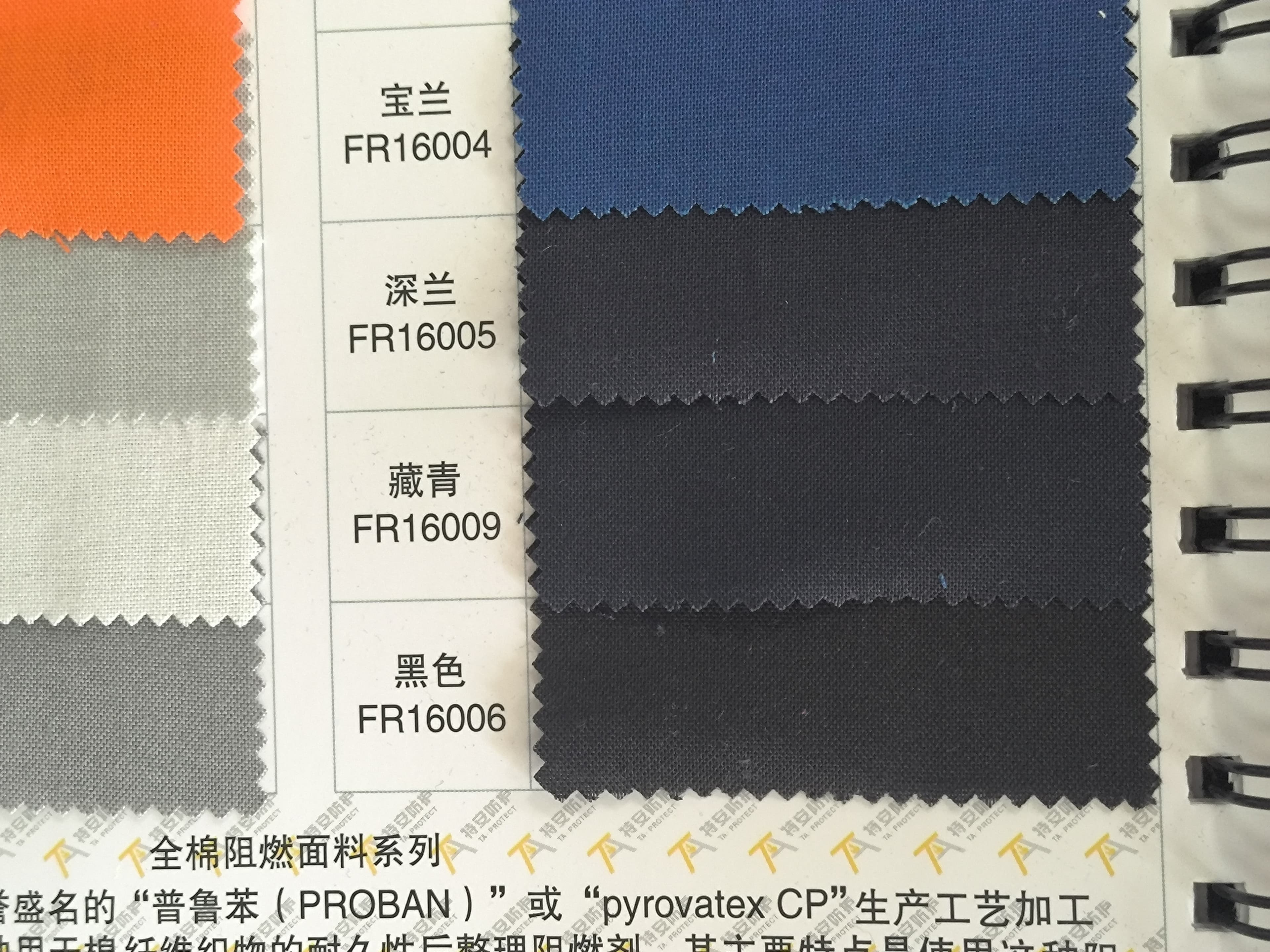
The orange fabric close-up and the two original swatch-card photographs add visible surface texture and color references to the material discussion. The opened-jacket and collar views show how the inside construction comes together. Any required protective specification still needs to be stated for the relevant product and configuration; appearance alone is not a substitute for that requirement.
4. Adapt the branding to each garment and PPE surface
A company logo does not occupy the same kind of space on a coverall, a jacket back and a curved helmet shell. The project therefore treated branding as a placement and production-method decision, alongside the garment’s pockets, attachment areas and reflective bands.
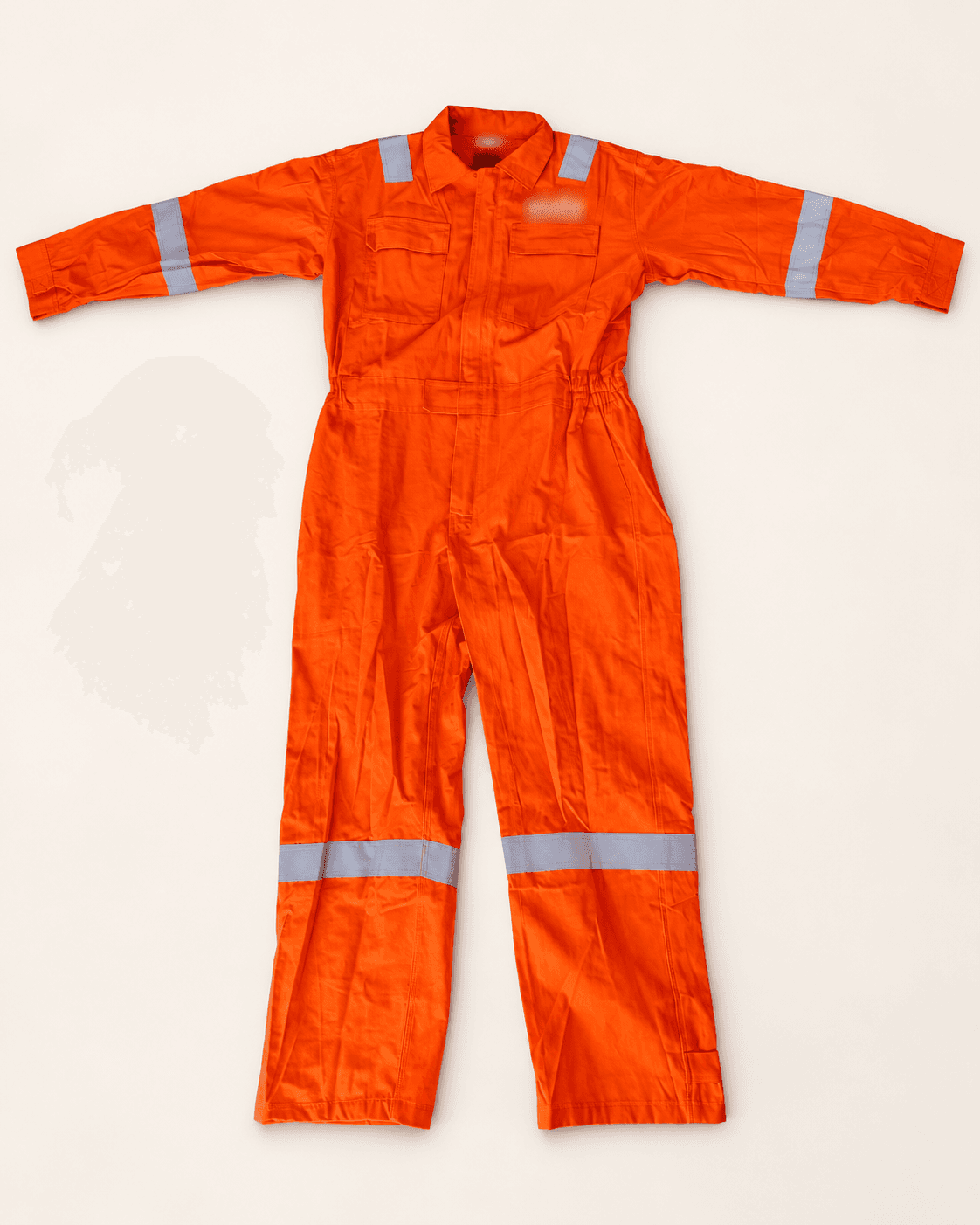
The coverall brief called for front and back printing, with hook-and-loop areas on both sleeves and the right chest. The winter-jacket brief specified embroidery on the back, which is visible in the original rear-view photograph before anonymization. Keeping those instructions product-specific avoided reducing the whole requirement to a single request to “add our logo.”
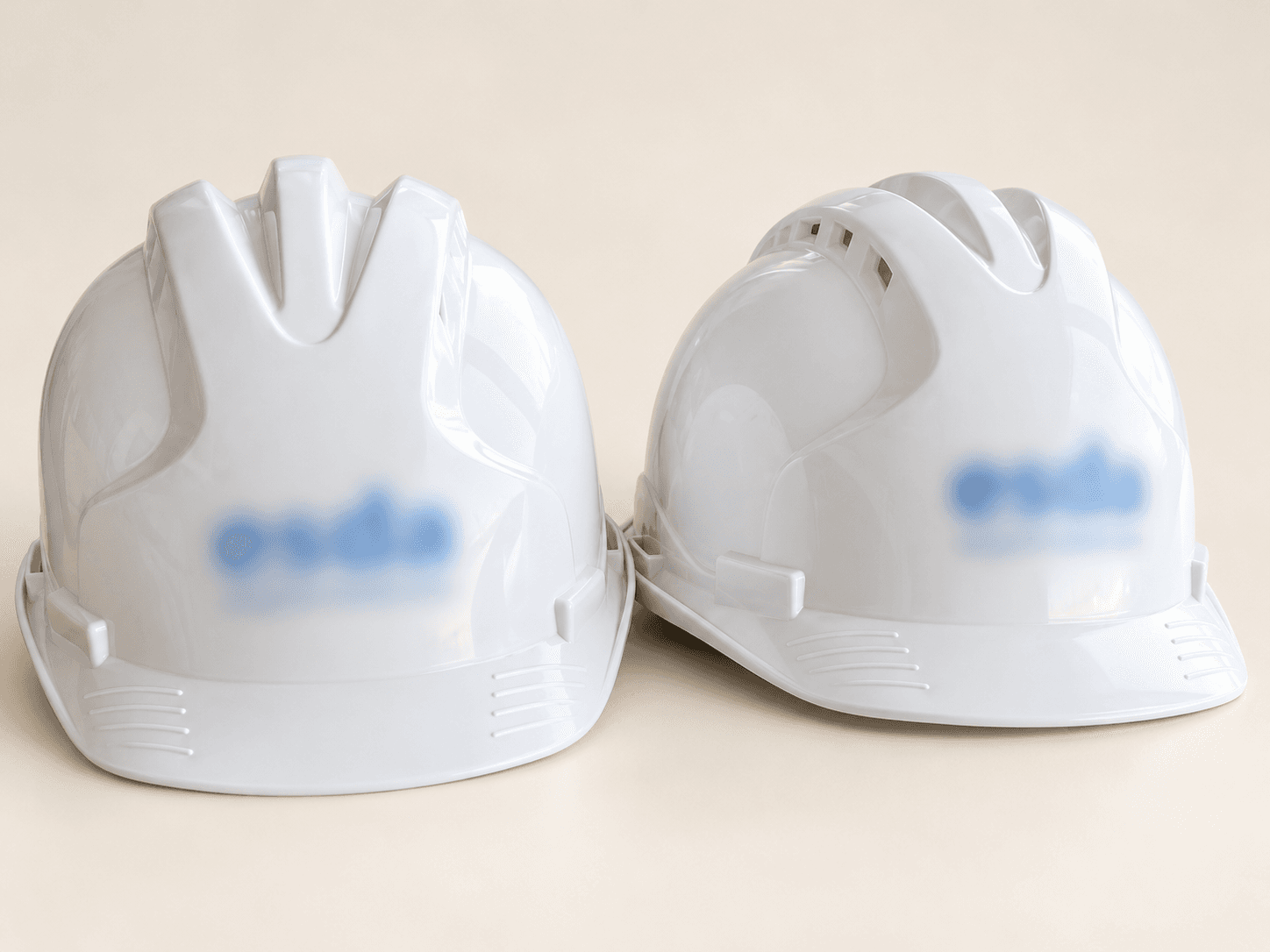
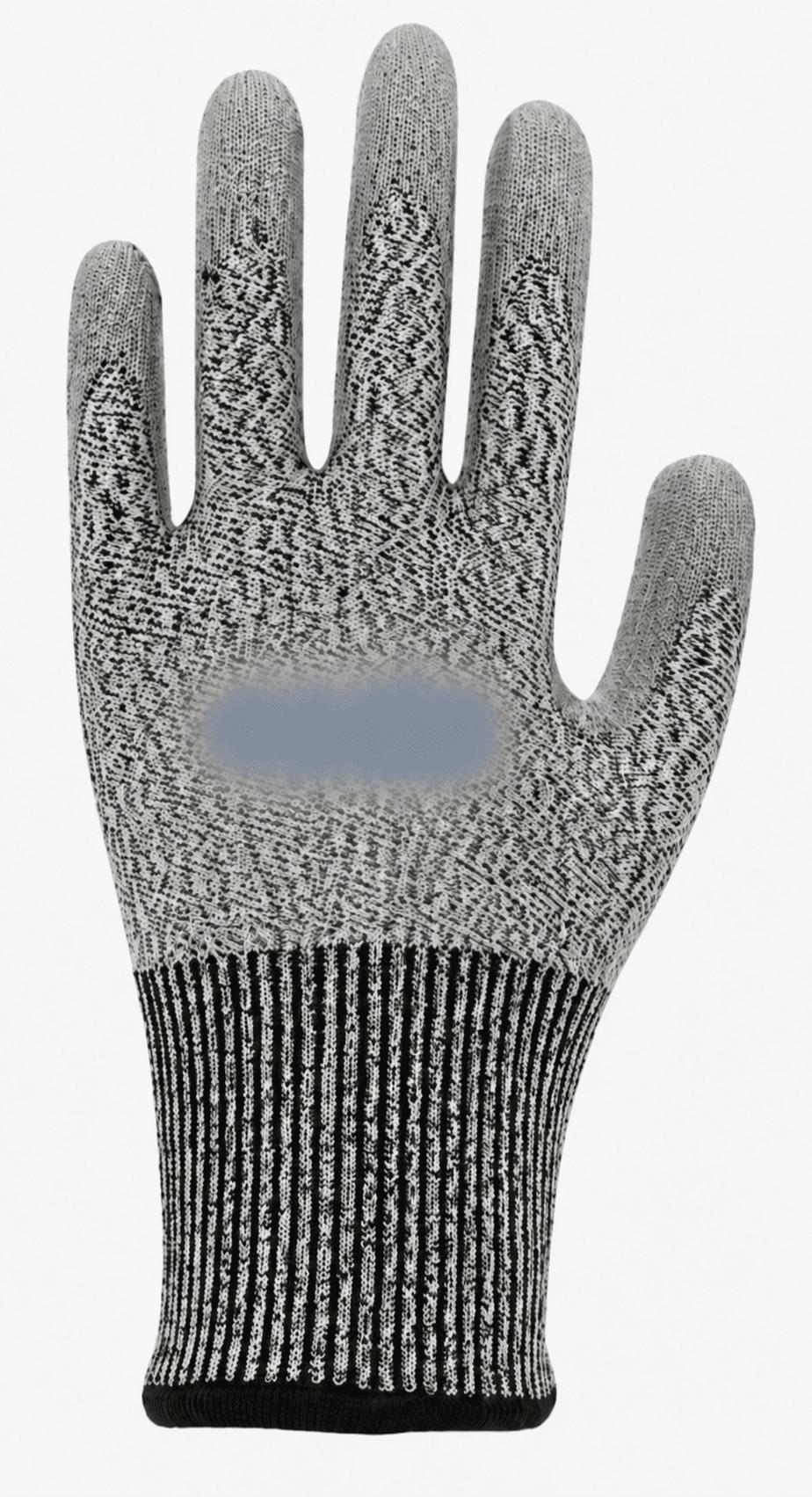
The helmet and glove references extended the discussion to different product surfaces. The helmet needed a smaller branding area on a curved shell; the glove reference showed another location and format. Separate quantities and customization instructions kept these accessories connected to the workwear program without losing their individual requirements.
The delivered result and the basis of the 80% saving
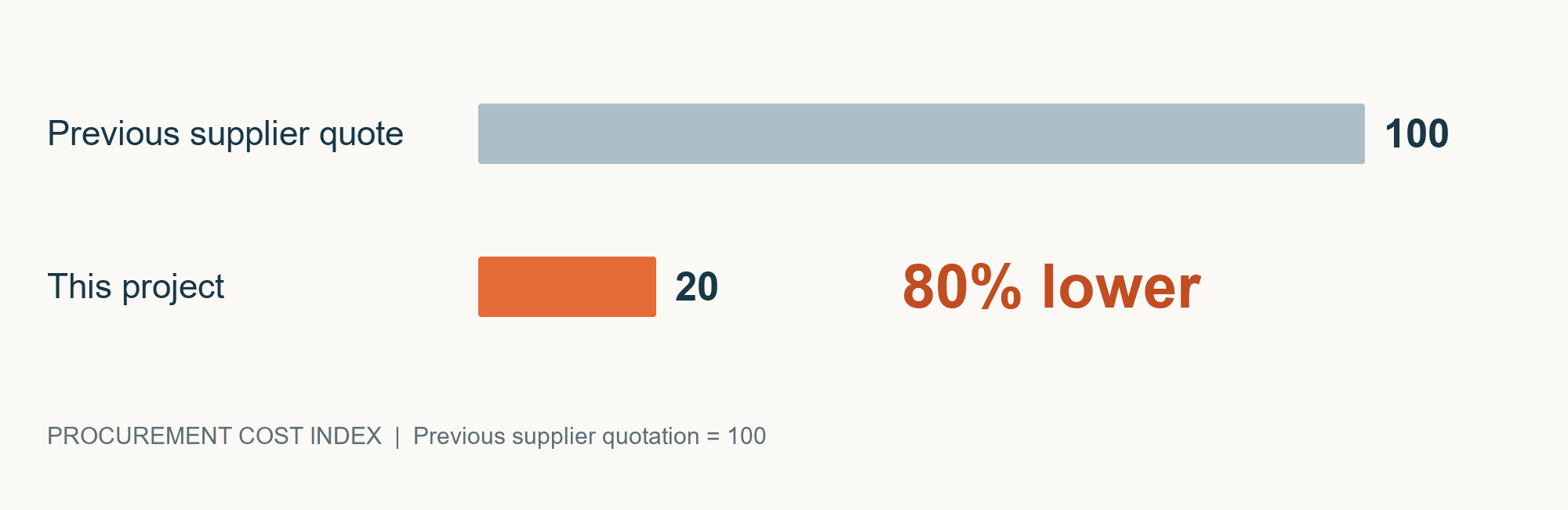
The project has been delivered: 1,000 coveralls, 310 winter jackets, 500 helmets, 500 pairs of eyewear and 100 pairs of gloves. Procurement costs were 80% lower than the customer’s previous supplier quotation. That quotation is the comparison baseline used throughout this case.
The calculation is (previous supplier quotation − this project’s procurement cost) ÷ previous supplier quotation × 100. Indexing the earlier quotation to 100 puts this project at 20, producing an 80% reduction. The chart presents that relative comparison as an indexed comparison rather than currency amounts.
The comparison supplied for this case does not specify whether freight, duties or taxes were included. The 80% figure applies to the overall workwear and PPE procurement project; it is not a price comparison for Portwest FR59 jackets alone. A new quotation needs its own product configuration and commercial scope.
The finished program combined a defined color and size schedule, a dedicated winter-jacket specification and branding adapted to different products. Those details give another purchasing team something concrete to evaluate: the scope of supply behind the headline cost result.
A practical checklist for comparing your next workwear proposal
Use the same questions when preparing a mixed workwear and PPE request. They help keep the commercial comparison connected to the products you intend to buy.
Product scope — Information to prepare: A separate line for each product, color, quantity and unit of purchase.
Garment fit — Information to prepare: Size quantities by garment line, plus measurement references and units.
Construction and materials — Information to prepare: Pocket, closure, adjustment, reflective-tape and shell/lining/filling requirements.
Branding — Information to prepare: Artwork, logo size, position and preferred method for each product.
Protective requirements and review records — Information to prepare: Site-selected requirements and the product-linked reports, samples or inspection records you need to review.
Commercial comparison — Information to prepare: Currency, delivery term, destination, required date and stated freight/tax inclusions or exclusions.
The checklist above can be used to prepare a new inquiry or review an existing supplier quotation. An editable procurement brief is available on request.
Questions buyers often ask before a mixed PPE order
Can different products have different order quantities?
Yes. This project combined 1,000 coveralls and 310 jackets with separate quantities for helmets, eyewear and gloves. State the required quantity and unit for each line; the purchasing list does not need to imply an equal number of complete kits.
What should accompany a reference photograph?
Add a size schedule, garment measurements, construction details and branding instructions. For an insulated jacket, include inside views and separate shell, lining and filling requirements. Photographs communicate appearance; the written brief records the details the supplier must quote.
How should I compare an alternative quotation?
Compare the product configuration and commercial scope alongside the price: quantities, sizes, materials, customization, required protective specifications and delivery terms. Record which costs are included or excluded before calculating a percentage saving.
Request a proposal for your workwear and PPE program
Send YUELAIFA your product list, quantities, size mix, branding artwork and required protective specifications. If you already have a quotation, include its product details and commercial scope so the alternative proposal can be discussed against a clear reference.
Use the checklist above to organize your requirements, then start a project inquiry through our quotation page.
Discuss your workwear and PPE project: https://www.laifappe.com/quote (opens in a new tab)
Explore workwear options: https://www.laifappe.com/categories/body-protection (opens in a new tab)
Client identity is anonymized. Project winter-jacket photos retain their original surroundings; rear branding is blurred. Other selected project images have cleaned backgrounds. The Portwest FR59 image identifies the customer’s previous model and is not a project delivery photograph. The glove image is a product reference.
Project information and the procurement-cost comparison were supplied by YUELAIFA. The client’s name is withheld for confidentiality.