Buyer next step
Turn this guide into a sourced PPE shortlist with standards, quantities, and role-based kit notes.
A bulk PPE order needs a traceable answer to a practical question: are the goods being packed the same models, sizes and configurations the buyer approved? A quotation, a sample and a carton photo answer different parts of that question. This checklist connects them before the buyer gives written permission to ship.
Use it after commercial scope and supplier selection, alongside the bulk PPE procurement guide and contractor PPE supplier checklist. It provides a record for procurement, safety reviewers and receiving teams; it does not replace their judgment.
Quick Answer: What Must Be Approved Before Bulk PPE Ships?
Approve the exact product baseline, verify the actual goods and packing against it, close discrepancies, then record a shipment decision. Keep these approvals separate so that acceptance of one sample cannot be read as permission to dispatch every item in an order.
- Identify the order line, manufacturer or supplier model, sample ID and approved revision.
- Match relevant product documents, instructions and markings to that exact configuration.
- Confirm the size and color split, fit review, compatible accessories and logo artwork.
- Compare shipment quantities, units, carton labels and packing with the approved requirements.
- Resolve substitutions and record evidence before an authorized person releases the defined shipment.
Download the blank sample approval and pre-shipment checklist to adapt these fields to your order. Complete it with the supplier and the people responsible for the site's PPE requirements.
Set Three Separate Approval Gates
Assign an owner and a written decision at each gate. The same person may hold several responsibilities, but the decision should still identify what was approved and what remains open.
| Gate | Decision being made | Record to retain |
|---|---|---|
| Sample and document baseline | Is this identified model and configuration acceptable for the stated scope? | Sample ID, document versions, review scope, conditions and reviewer |
| Pre-shipment verification | Do the goods and packing checked match that baseline? | Observations, evidence, quantities checked and discrepancy disposition |
| Shipment release | May this defined shipment leave with the recorded conditions? | Hold, Recheck or Released decision, shipment scope, name and date |
For a mixed order, approval of helmets must not silently approve gloves or footwear. Record partial approvals by line and quantity. Agree who can hold the shipment, who reviews safety suitability and who has authority to release it. Receiving inspection after arrival remains a separate gate, even when pre-shipment checks passed.
Record the Approved Sample and Document Baseline
Give each reviewed sample an identifier linked to the order line and model. Keep the physical sample where practical, supported by dated photos showing the product, markings, packaging and relevant accessories. A general product photograph is too weak to identify a change in suspension, coating, lens or fastening.
| Baseline field | What the buyer records |
|---|---|
| Order identity | Buyer, project, order reference, supplier, record revision and reviewer |
| Product identity | Line, category, exact model, sample ID, size, color and configuration |
| Document identity | Document ID, version or date, issuer, model coverage and reviewed scope |
| Evidence | Photo filenames or links, sample location and any observations |
| Decision | Approved, Pending or Rejected; approval scope, conditions, name and date |
An Approved decision should say whether it covers appearance, fit, documents, packing or another defined scope. Pending means unresolved points remain. Rejected needs a reason and a required next step. Do not let a short email saying “looks good” become the only baseline.
Compare document model names and variants with the item being offered. Ask the reviewer to address discrepancies rather than assuming a related model's report applies. Preserve manufacturer instructions and marking details in the record. When the underlying specification changes, issue a new revision and identify the superseded approval. If the buying scope itself is incomplete, return to the construction PPE RFQ template before approving samples.
Check Fit and the Complete PPE Combination
Use sample review to test the intended size range and the equipment worn together. A helmet and earmuff may each appear acceptable separately while their combined arrangement creates an issue. Check eyewear with the intended respirator and face protection, and clothing with the actual harness arrangement where applicable. Use manufacturer instructions and competent safety review to decide suitability.
For US construction work, OSHA 1926.95 requires employers to select PPE that properly fits affected employees. HSE selection guidance also addresses suitability, fit and compatibility when equipment is worn together. Apply the requirements relevant to the destination and workplace; this procurement checklist is not a universal compliance determination.
Record who tried which sizes, what combination was checked, the activity and any limitations. A fit trial on one person cannot establish fit for the entire workforce. For tight-fitting respirators, a buying sample review is separate from the employer's medical evaluation, fit testing and respiratory protection program duties under applicable rules such as OSHA 1910.134. NIOSH respirator guidance is an additional selection reference.
The mining and quarrying PPE solution can help organize a multi-category order by task. Keep each task's approval scope visible in the order record.
Lock Logo Artwork, Sizes and Packing Instructions
Create a final artwork reference with revision, color, dimensions, position and application method. Obtain the appropriate manufacturer's confirmation or instructions for decoration where it could affect equipment performance or markings. A buyer's visual approval alone does not establish that an application is suitable.
Freeze the size and color split by line, including spare sizes and any worker-kit allocation. State the unit explicitly: pieces, pairs, sets or kits. Reconcile the total with the purchase order and final packing plan. The PPE quantity calculator can support initial planning; the signed order split remains the reference for this verification.
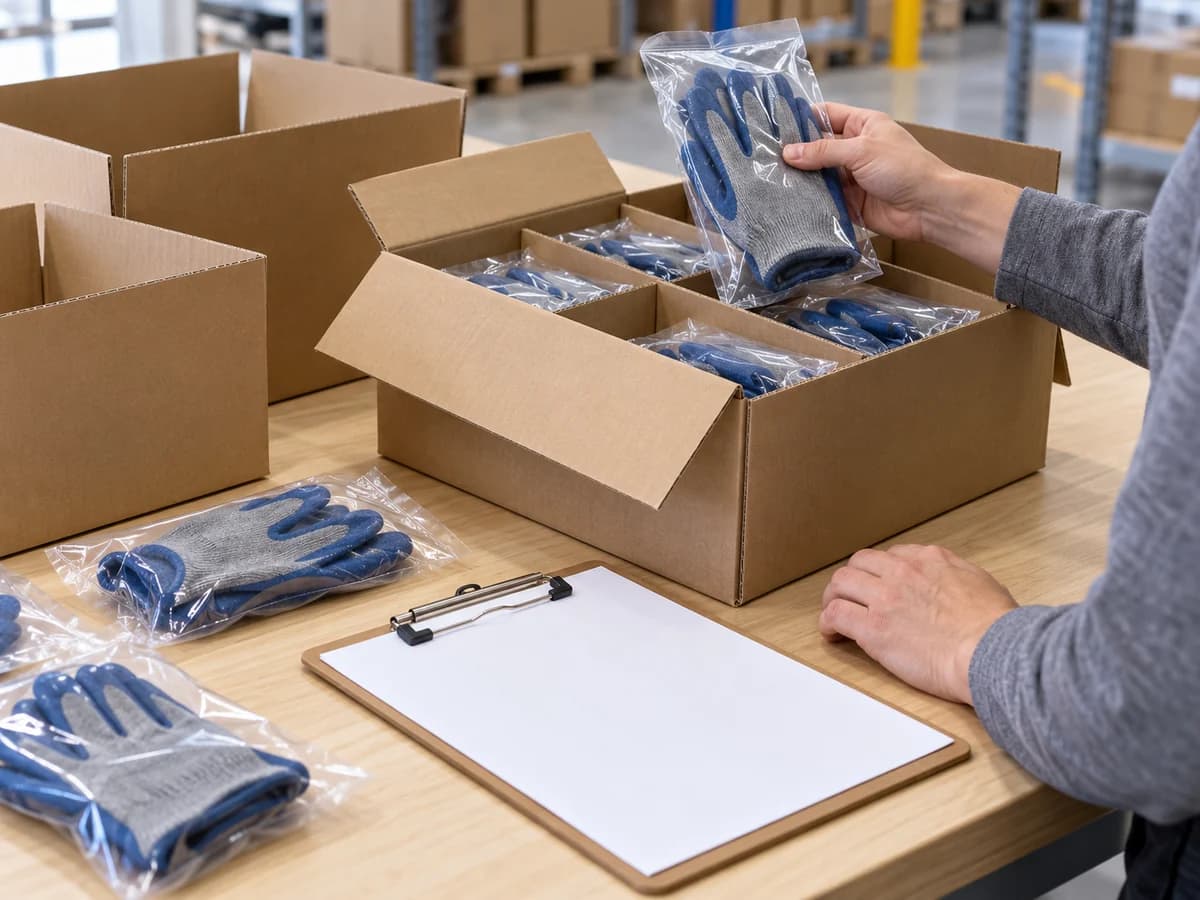
Give the packing instructions their own revision. Record carton or kit identifiers, contents, size labels and the packing-list fields receiving teams need. Define how mixed cartons are identified. Keep transport labels separate from product markings, and check that packaging or artwork does not conceal required information. If the packing plan changes, obtain review before treating the revised plan as approved.
Use a Pre-Shipment Verification Record
Compare the actual goods with the approved baseline while discrepancies can still be addressed. Agree the inspection scope, access, timing and evidence format with the supplier and a qualified inspector or reviewer. Decide sampling with those responsible for the order's risk and applicable requirements; this article does not prescribe a universal AQL or sample size.
| Approved requirement | Observed result and evidence | Discrepancy and disposition |
|---|---|---|
| Model, variant and markings | Record the identity checked and linked photos | Identify mismatch, action owner and recheck |
| Quantity, unit and size/color split | Record counts checked and packing-list comparison | Describe shortages, overages or allocation differences |
| Artwork and packing revision | Record location, labels and carton/kit evidence | State correction required and evidence of closure |
Record the date, location, shipment reference, lot or batch identifiers where available, number and selection of units checked, and the checks actually performed. Keep observations factual: “carton label shows size L” is different from proving every unit inside is size L.
Use evidence that can be traced back to the inspected goods. A close-up of a marking needs a product or carton reference; a wide warehouse photograph needs context. Photos support identity and visible-condition checks but cannot establish protective performance or hidden characteristics. Record checks that were not performed rather than leaving blanks that could imply a pass.
The South Africa mining PPE procurement case provides context for a multi-category buying project. It is not evidence that the approval or verification procedure described here was performed for that order.
Close Substitutions and Discrepancies Before Release
Require a proposed substitute to identify the original line, replacement model, reason, changed properties, document coverage, size availability, compatibility and schedule effect. Appearance or a supplier's “equivalent” statement is insufficient. Send changes affecting protective suitability back to the responsible safety reviewer and update the approved baseline when accepted.
Keep a discrepancy log with an ID, requirement, observed difference, evidence, owner, due date, proposed disposition and closure evidence. Separate correction from acceptance: a supplier saying “corrected” still needs the agreed recheck. If a discrepancy is accepted, state its exact scope and the authority for that decision. A commercial concession does not make an unsuitable item suitable.
Use Hold when release conditions are unmet, Recheck when corrective evidence or another inspection is required, and Released only for the identified lines and quantities authorized to ship. Record the decision maker, date and conditions. Attach unresolved-item handling to any partial release so excluded goods are not packed by mistake.
Copy the Buyer Sign-Off Checklist
Use the downloadable form as a blank working record. Complete one baseline per distinct product configuration and connect it to the shipment verification, rather than copying one approval across every line.
- Record buyer, project, order, supplier, revision and reviewer.
- Identify each line, category, exact model, sample ID and document ID/version/scope.
- Attach photo evidence and define what the approval covers.
- Confirm quantity and unit, size/color split, fit and complete-PPE compatibility review.
- Reference logo artwork version/location and packing revision.
- Select Approved, Pending or Rejected, with conditions and authorized signature.
- Compare approved requirements with observed shipment results and evidence.
- Close each substitution or discrepancy with a recorded disposition and recheck.
- Sign Hold, Recheck or Released for the named shipment, lines and quantities.
- Send the controlled record to receiving staff for their separate arrival checks.
Keep completed records with access controls appropriate to worker details, commercial terms and supplier documents. The public download is a blank template. To discuss the models, documents and packing information needed for a planned order, request a PPE quotation with your project scope.
What This Checklist Does Not Prove
A completed record does not certify PPE, validate a document's authenticity by itself, demonstrate every unit's performance or guarantee that transport caused no damage. Sample approval does not replace workplace hazard assessment, required testing, training, user inspection, maintenance or replacement routines.
Shipment release also differs from final acceptance on arrival. Receiving teams should reconcile cartons, quantities, sizes, identity and visible condition against the shipment records, then manage discrepancies under the purchase agreement. Keep inspection responsibility, contractual acceptance, logistics terms and payment decisions explicit rather than inferring them from a checklist signature.
Frequently Asked Questions
Does sample approval authorize the supplier to ship?
Only if the agreement expressly gives it that meaning. This workflow separates sample approval from shipment release. Identify who may authorize dispatch and retain that written decision for the defined goods.
Can photos replace a pre-shipment inspection?
Photos can document specified visible checks, but their scope is limited. Agree when remote evidence is sufficient and when physical verification or testing is needed with the buyer's qualified reviewer. Record what was and was not checked.
Must every unit in a bulk PPE order be checked?
There is no single inspection scope suitable for every order. Agree checks, sampling, acceptance criteria and escalation before inspection, using the product risk, buyer requirements and relevant rules. Do not copy a sample size without that context.
What if the supplier changes a product after sample approval?
Hold the affected line for review. Compare the replacement with the baseline, obtain the necessary documents and trials, and record written acceptance or rejection. Update the baseline before checking the changed goods for release.
Related PPE
Source the PPE covered in this guide
Move from research to a buyer shortlist with the matching solution page, category paths, selected PPE options, and RFQ next steps.
Related Tools
Turn this guide into a faster PPE shortlist
Use the matching tools to check footwear sizing, decode certification labels, or estimate order quantities before you move from research to purchasing.
PPE Quantity Calculator
Estimate monthly usage, replacement cycles, and budget needs before you place a bulk PPE order.
Plan quantitiesSafety Boot Size Guide
Convert US, EU, UK, CN, and JP sizing and check width fittings before you lock in footwear specs.
Check sizingSafety Footwear Label Decoder
Decode ASTM F2413 and EN ISO 20345 markings such as S3, SRC, HRO, EH, and PR in seconds.
Decode labels